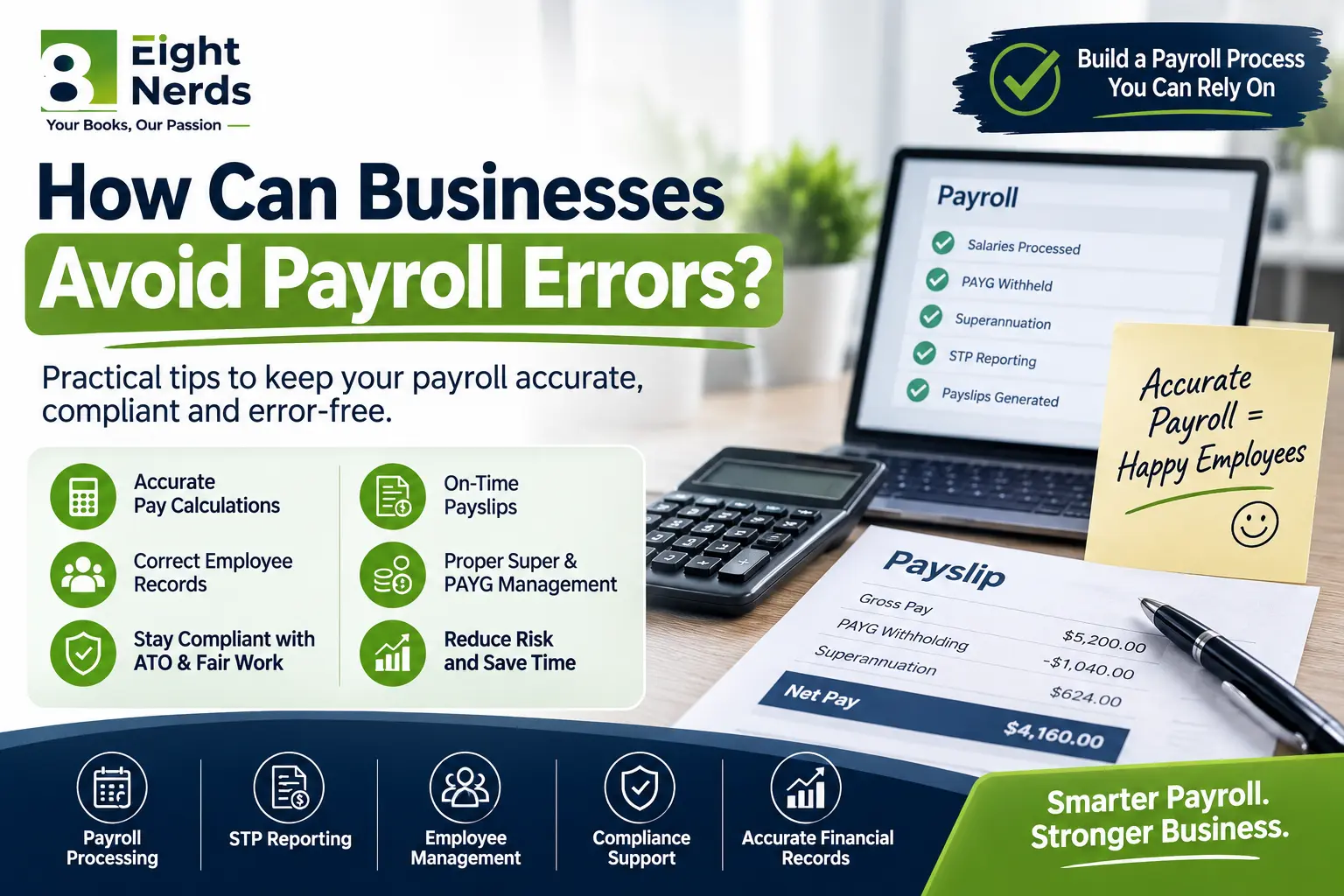
How Can Businesses Avoid Payroll Errors?
Payroll errors can be costly for a business. A small mistake in an employee’s pay rate, working hours, tax withholding, leave balance or superannuation can create problems for both the employee and the employer.
So, how can businesses avoid payroll errors? The answer is to combine accurate employee information, consistent payroll processes, reliable payroll software, regular checks and proper record keeping.
Payroll is not simply about paying employees on time. Australian businesses also need to manage obligations relating to PAYG withholding, superannuation, payslips, Single Touch Payroll (STP), employee records and workplace entitlements.
The Fair Work Ombudsman states that employers must keep accurate employee records and that good record keeping can help businesses identify payroll mistakes and operate more efficiently.
How Can Businesses Avoid Payroll Errors With Accurate Employee Information?
One of the simplest ways businesses can avoid payroll errors is to make sure employee information is correct from the beginning.
Payroll depends on information such as:
- Employee name and personal details
- Employment type
- Pay rate
- Tax information
- Bank account details
- Superannuation information
- Leave entitlements
- Working hours
- Applicable allowances or deductions
If the information entered into the payroll system is incorrect, even the best payroll software can produce an incorrect result.
For example, if an employee’s pay rate is not updated after a salary change, the business may continue paying the wrong amount until someone identifies the error.
A simple payroll information check should include:
| Payroll Information | What to Check |
|---|---|
| Pay rate | Is the current rate correct? |
| Employment type | Full-time, part-time or casual? |
| Hours | Are ordinary and overtime hours accurate? |
| Tax details | Are withholding details current? |
| Superannuation | Is the correct fund and contribution information recorded? |
| Leave | Are leave balances updated? |
| Bank details | Has the employee provided the correct account? |
Regularly reviewing employee information can prevent small data-entry errors from becoming recurring payroll problems.
How Can Businesses Avoid Payroll Errors by Checking Employee Hours?
Incorrect hours are another common source of payroll errors.
This can happen when businesses rely on memory, spreadsheets or informal messages instead of a consistent time-recording process.
Employees may work:
- Ordinary hours
- Overtime
- Weekend hours
- Public holiday hours
- Additional shifts
- Different hours from their usual roster
These differences can affect the amount an employee should be paid.
Fair Work guidance recommends keeping accurate records of hours worked, including overtime, and employers generally need to retain time and wage records for seven years.
To reduce errors:
- Use a consistent timesheet or time-tracking system.
- Require employees or managers to approve timesheets.
- Check unusual hours before processing payroll.
- Compare timesheets with rosters where appropriate.
- Keep records of overtime and applicable allowances.
This creates a clear process between the hours worked and the final payroll calculation.
How Can Businesses Avoid Payroll Errors With Regular Payroll Reviews?
Businesses should not simply run payroll and assume everything is correct.
A short review before final approval can identify many common mistakes.
Before processing a pay run, check:
- Are all employees included?
- Are any employees missing?
- Have pay rates changed?
- Are overtime hours correct?
- Are leave requests entered?
- Are bonuses or allowances included?
- Are deductions correct?
- Does the total payroll look reasonable compared with previous periods?
Payroll variance checks
A useful approach is to compare the current payroll with the previous pay period.
For example:
| Check | Previous Pay Run | Current Pay Run | Question |
|---|---|---|---|
| Total gross wages | $48,500 | $62,900 | Why did payroll increase? |
| Employee count | 18 | 18 | No change |
| Overtime | $2,100 | $9,700 | Were extra hours approved? |
| Allowances | $1,250 | $1,300 | Expected increase? |
A significant unexplained change does not necessarily mean there is an error, but it should be investigated before payroll is finalised.
How Can Businesses Avoid Payroll Errors in PAYG Withholding?
PAYG withholding is another important part of Australian payroll.
Employers may need to withhold amounts from payments made to employees and other workers and report and pay those amounts to the ATO according to their obligations.
Errors can occur when:
- Employee tax information is entered incorrectly
- Payroll settings are outdated
- Employee circumstances change
- Incorrect withholding calculations are used
- Payroll information is reported incorrectly
Businesses should use appropriate payroll software and keep employee tax information current.
The ATO also provides guidance on payroll governance and recommends businesses have processes appropriate to their size, type and complexity.
How Can Businesses Avoid Payroll Errors With Correct Superannuation?
Superannuation should also be checked as part of the payroll process.
Businesses need to ensure eligible employees receive the required superannuation contributions and that payroll records accurately reflect those contributions.
Common problems can occur when:
- Employee super fund details are incorrect
- Contribution settings are wrong
- Employee classifications are incorrect
- Payroll software is not configured properly
- Superannuation information is not reconciled
Rather than assuming the payroll system is correct, businesses should periodically review their superannuation settings and reports.
How Can Businesses Avoid Payroll Errors With Accurate Payslips?
Payslips provide employees with important information about how their pay has been calculated.
Under Fair Work requirements, employees must receive a payslip within one working day of payday. Payslips must contain required information about the payment, including gross and net amounts and relevant deductions, allowances and superannuation information.
Businesses should therefore make sure their payroll system produces complete and accurate payslips.
Before issuing payslips, check:
- Employee name
- Payment date
- Pay period
- Gross pay
- Net pay
- Tax withheld
- Allowances
- Deductions
- Superannuation information
A correct payslip is an important part of an accurate payroll process.
How Can Businesses Avoid Payroll Errors Through Proper Record Keeping?
Good record keeping is one of the strongest ways to prevent recurring payroll mistakes.
Australian employers generally need to keep employee time and wage records for seven years. These records can include pay, hours worked, leave and superannuation information.
Keeping organised records allows businesses to:
- Investigate payroll discrepancies
- Answer employee questions
- Review historical pay
- Identify recurring errors
- Support compliance checks
- Provide information to payroll and accounting professionals
Records should also be kept securely because employee payroll information is private and confidential.
How Can Businesses Avoid Payroll Errors With Payroll Software?
Payroll software can automate many repetitive calculations and reporting tasks, but software is not a substitute for proper payroll processes.
A payroll system can help with:
- Employee records
- Pay calculations
- Payslips
- Leave tracking
- PAYG withholding
- Superannuation calculations
- Payroll reporting
- Single Touch Payroll
However, incorrect settings or employee information can still result in incorrect payroll.
The best approach is:
Accurate data → Correct payroll settings → Automated calculations → Human review → Payroll approval → Reporting
This combination reduces the risk of relying entirely on either manual calculations or automation, and with support from Eight Nerds, businesses can further improve accuracy and control.
Common Payroll Errors Businesses Should Avoid
| Payroll Error | Potential Problem | Prevention |
|---|---|---|
| Incorrect pay rate | Employee underpayment or overpayment | Review employee rates regularly |
| Incorrect hours | Wrong wages | Use approved timesheets |
| Missing overtime | Employee may not receive correct pay | Check overtime before payroll |
| Incorrect PAYG | Tax reporting problems | Keep tax information updated |
| Incorrect super settings | Contribution errors | Review super details |
| Missing leave | Incorrect employee balances | Approve and update leave |
| Incorrect deductions | Wrong net pay | Verify deductions |
| Incorrect payslip | Compliance issue | Review payroll output |
| Poor record keeping | Difficult to investigate errors | Maintain organised records |
| No payroll review | Errors may go unnoticed | Use a pre-payroll checklist |
How Can Businesses Avoid Payroll Errors When Payroll Gets More Complex?
Payroll becomes more difficult as a business grows.
A business with five employees may have a relatively simple payroll process. A business with 50 employees may need to manage different pay rates, departments, employment arrangements, overtime, leave, allowances and reporting requirements.
The more complex payroll becomes, the more important it is to have:
- Documented payroll procedures
- Clear approval responsibilities
- Reliable payroll software
- Regular reconciliation
- Employee data checks
- Payroll reporting reviews
- Professional payroll support when required
This is particularly important for businesses where payroll is processed by more than one person.
Can Outsourcing Payroll Help Businesses Avoid Payroll Errors?
Yes. Outsourcing payroll can provide businesses with access to professionals who regularly manage payroll processes and understand the importance of accurate records and compliance.
Professional payroll support can help with:
- Payroll processing
- Employee data management
- PAYG withholding
- Payslips
- Superannuation information
- Payroll reporting
- Payroll reconciliations
- Bookkeeping integration
Outsourcing can also reduce the risk of payroll becoming dependent on one employee who may be unavailable due to leave or staff turnover.
For businesses that do not have an internal payroll specialist, professional payroll management can provide an additional layer of review and process control.
A Simple Payroll Error Prevention Checklist
Before approving each payroll run, businesses can ask:
- Are all employees included?
- Are employee pay rates correct?
- Have all timesheets been approved?
- Are overtime and allowances correct?
- Have leave records been updated?
- Are deductions accurate?
- Are PAYG calculations correct?
- Are superannuation details correct?
- Does the payroll total look reasonable?
- Are payslips ready with the required information?
- Has the payroll been reviewed before final approval?
- Are payroll records stored securely?
Using a checklist creates a repeatable process and reduces the chance that an important step will be missed.
How 8Nerds Helps Businesses Manage Payroll Accurately
At 8Nerds, payroll management is part of our broader bookkeeping and financial management support for Australian businesses.
Led by Tapish Arora, Founder of 8Nerds, the team brings 12+ years of accounting experience, including experience with prestigious CA firms and Top 10 accounting firms in Australia.
Our payroll support can help businesses manage:
- Payroll processing
- Employee payroll records
- Payslips
- Payroll reporting
- Superannuation information
- PAYG-related payroll processes
- Payroll reconciliations
- Integration between payroll and bookkeeping
The objective is to create a payroll process that is accurate, organised and easier for business owners to review.
Frequently Asked Questions About How Businesses Can Avoid Payroll Errors
What is the best way to avoid payroll errors?
The best approach is to maintain accurate employee information, use reliable payroll software, check timesheets, review payroll before approval and keep complete payroll records.
What are the most common payroll errors?
Common errors include incorrect pay rates, wrong hours, missed overtime, incorrect deductions, incorrect PAYG withholding, superannuation errors and incomplete employee records.
How often should payroll be checked?
Payroll should be checked before every pay run. Businesses should also conduct periodic reviews of employee information, payroll settings and historical payroll reports.
How long should payroll records be kept in Australia?
Employers generally need to keep employee time and wage records for seven years.
When should a business outsource payroll?
A business may consider outsourcing when payroll becomes time-consuming, complex, difficult to manage internally or when recurring errors start appearing.
Can payroll software prevent all payroll errors?
No. Payroll software can automate calculations and reporting, but incorrect employee information or incorrect settings can still result in errors. Human review remains important.
Final Thoughts: How Can Businesses Avoid Payroll Errors?
So, how can businesses avoid payroll errors? It starts with getting the basics right: accurate employee information, reliable time records, correct payroll settings, regular reviews and proper record keeping.
Australian businesses also need to pay attention to PAYG withholding, superannuation, payslips, Single Touch Payroll and workplace record-keeping requirements.
The most effective payroll process is not necessarily the most complicated one. It is a consistent process where information is checked, payroll is reviewed before approval, records are maintained properly and potential issues are addressed early.
For businesses without the time or internal expertise to manage these responsibilities, professional payroll and bookkeeping support can provide an additional layer of accuracy, organisation and confidence. Book Your Appointment today.

All Categories
Recent Posts


What is Business Expense Management ? How Australian Businesses Can Control Rising Costs