
What Is BAS and Does Every Australian Business Need to Lodge It? | BAS Australia Guide
If you run a business in Australia, you have probably come across the term BAS, short for Business Activity Statement. But what exactly is BAS, who needs to lodge it, how often does it need to be lodged, and what information does an Australian business need to report?
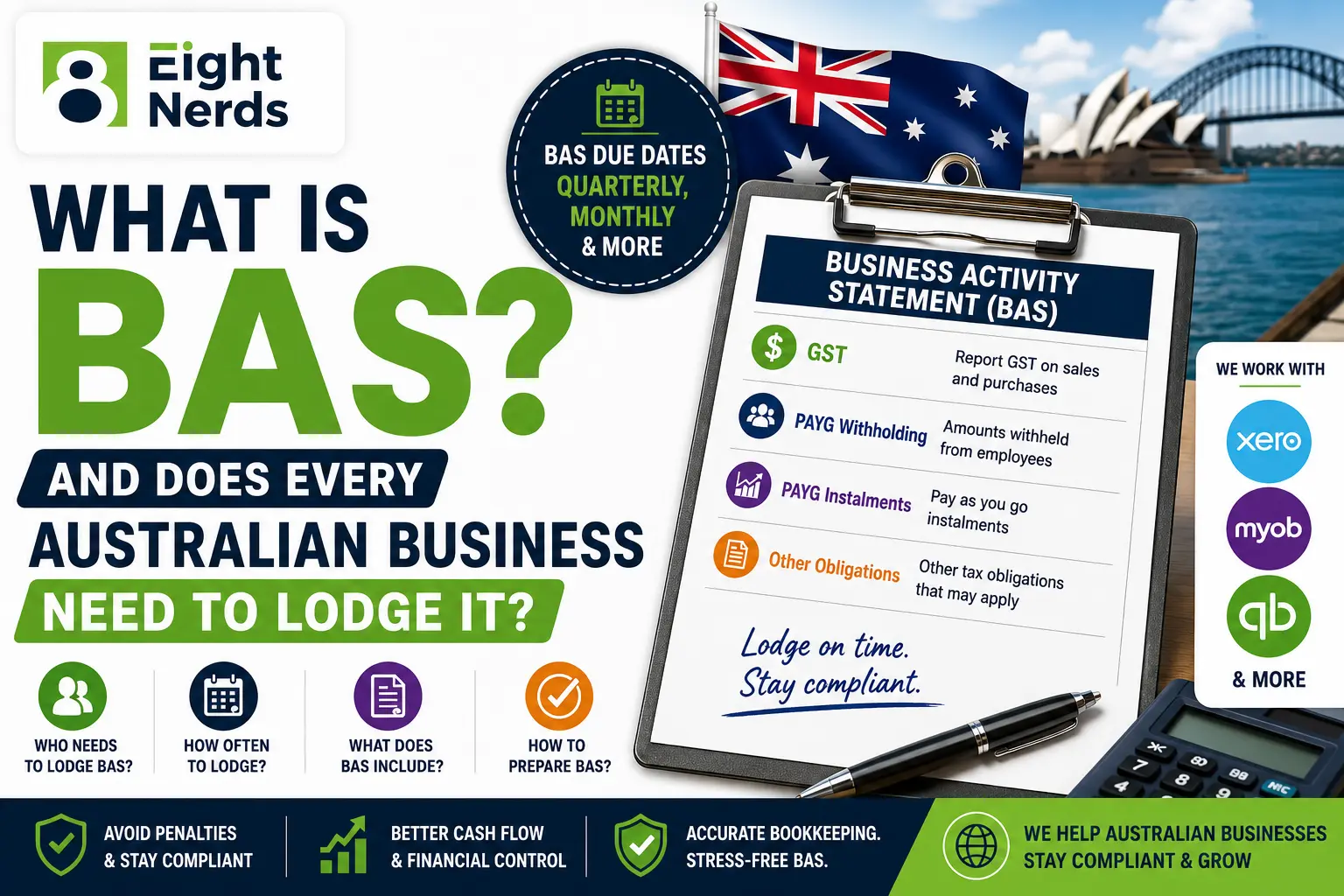
A Business Activity Statement (BAS) is used by Australian businesses to report and pay certain tax obligations to the Australian Taxation Office (ATO). For many businesses, this includes Goods and Services Tax (GST), while a BAS can also include PAYG withholding, PAYG instalments, and other applicable obligations.
However, not every Australian business automatically needs to lodge a BAS. Your BAS obligations depend on factors such as whether your business is registered for GST and whether you have other tax reporting obligations.
Understanding BAS Australia requirements is important because accurate bookkeeping, GST reporting, and timely BAS lodgement can help businesses remain compliant and avoid unnecessary problems with the ATO.
What Is BAS in Australia?
BAS stands for Business Activity Statement. It is a statement used by Australian businesses to report certain business tax obligations to the Australian Taxation Office.
For a GST-registered business, BAS is commonly used to report the GST collected from customers and claim eligible GST credits on business purchases. Depending on the business, the statement may also include PAYG withholding, PAYG instalments, and other tax obligations.
The ATO explains that businesses use BAS to report and pay GST and other applicable obligations.
In simple terms:
GST is the tax, while BAS is the statement used to report GST and other applicable business tax obligations to the ATO.
For example, suppose an Australian GST-registered business sells taxable services for $11,000 including GST. The GST component of that sale is $1,000. If the business also has eligible purchases that include $300 of GST, it may have a net GST amount of $700 before considering any other relevant adjustments or obligations.
This is why accurate bookkeeping is essential when preparing a BAS.
Does Every Australian Business Need to Lodge a BAS?
No, not every Australian business needs to lodge a BAS.
A major reason a business needs to lodge BAS is because it is registered for GST. Generally, an Australian business must register for GST when its GST turnover reaches $75,000 or more. The threshold is $150,000 for not-for-profit organisations, while taxi and ride-sourcing operators have specific GST registration requirements.
Businesses below the GST registration threshold can generally choose whether to register for GST, depending on their circumstances.
Once a business is registered for GST, it generally needs to lodge a BAS according to its assigned reporting cycle.
Other businesses may also receive an activity statement because they have obligations such as PAYG withholding or PAYG instalments.
Therefore, simply having:
- An ABN
- A registered business name
- Business income
- A business bank account
does not automatically mean that every business must lodge BAS.
The important question is whether your business has a relevant ATO reporting obligation.
What Is GST and How Does It Relate to BAS Australia?
GST, or Goods and Services Tax, is a 10% tax on most goods, services, and other taxable items sold or consumed in Australia.
If your business is registered for GST, you generally include GST in the price of taxable goods and services you sell. You then report the GST collected through your BAS.
A GST-registered business can also generally claim GST credits for eligible business purchases where the relevant requirements are met.
For example:
GST collected from customers: $5,000
Eligible GST credits: $2,000
Net GST position: $3,000
The actual BAS calculation can be more complex depending on the business, adjustments, accounting method, and other obligations.
This is why businesses should maintain accurate records throughout the BAS reporting period rather than trying to reconstruct transactions at the last minute.
What Does a BAS Include?
The information reported on a BAS depends on the business’s tax registrations and reporting obligations.
For many eligible small businesses using Simpler BAS, GST reporting is reduced to three main labels:
- G1 – Total sales
- 1A – GST on sales
- 1B – GST on purchases
The ATO’s Simpler BAS system was designed to reduce the amount of GST information small businesses need to report.
Depending on the business, a BAS may also contain information relating to:
- GST
- PAYG withholding
- PAYG instalments
- Fuel tax credits
- Wine equalisation tax
- Luxury car tax
- Other applicable tax obligations
Not every business will have to complete every section.
BAS Lodgement Frequency in Australia
One of the most common BAS Australia questions is how often a business needs to lodge its BAS.
The reporting cycle generally depends on the business’s GST turnover and circumstances.
Quarterly BAS Reporting
Many Australian small businesses report GST quarterly.
If a business has GST turnover below $20 million and has not been required to report monthly, it can generally report GST quarterly.
The standard quarterly BAS periods and due dates are:
| BAS Quarter | Period | Standard Due Date |
|---|---|---|
| Quarter 1 | July – September | 28 October |
| Quarter 2 | October – December | 28 February |
| Quarter 3 | January – March | 28 April |
| Quarter 4 | April – June | 28 July |
The actual due date shown on your BAS should always be checked because extensions or different arrangements may apply.
Eligible businesses may also receive additional time when lodging electronically or through a registered tax or BAS agent.
Monthly BAS Reporting
Businesses with GST turnover of $20 million or more generally need to report and pay GST monthly unless the ATO has advised otherwise. Businesses below that threshold can also choose monthly GST reporting in certain circumstances.
Monthly BAS is generally due on the 21st day of the following month.
For example, a July monthly BAS is generally due on 21 August.
Annual GST Reporting
Some businesses that are voluntarily registered for GST and have turnover below the applicable threshold may be eligible to report GST annually.
The standard annual GST return due date is generally 31 October, although different rules can apply depending on whether the business also needs to lodge an income tax return.
BAS and PAYG Withholding
BAS can also include PAYG withholding.
If an Australian business has employees, it may need to withhold tax from employee wages and other applicable payments. The withheld amounts need to be reported and paid to the ATO.
The ATO states that PAYG withholding amounts are reported in the relevant section of the business activity statement.
This makes accurate payroll records particularly important.
Before preparing BAS, businesses with employees should ensure that:
- Payroll records are accurate.
- PAYG withholding has been correctly calculated.
- Payroll transactions have been recorded.
- Relevant payments have been reconciled.
- STP records are consistent with the accounting records.
Payroll and bookkeeping should therefore work together rather than being treated as completely separate processes.
BAS and PAYG Instalments
Another obligation that may appear on an Australian business’s activity statement is PAYG instalments.
PAYG instalments are generally advance payments towards expected income tax obligations. They are different from PAYG withholding, which generally relates to tax withheld from payments such as employee wages.
A business owner may therefore see PAYG-related information on their activity statement even when the business’s primary reason for lodging BAS is GST.
Because PAYG instalment obligations depend on the taxpayer’s circumstances, businesses should review the information on their specific activity statement rather than assuming that every business is treated in exactly the same way.
Do I Need to Lodge BAS If My Business Had No Sales?
This is an important question for Australian business owners.
If the ATO has issued an activity statement that requires lodgement, you generally still need to lodge it even if your business had no sales or little activity during the reporting period.
This may result in what is commonly referred to as a nil BAS.
The important point is that having no sales does not automatically mean you can ignore an activity statement issued by the ATO.
If your business has stopped trading, cancelled its GST registration, or experienced a significant change in circumstances, you should make sure the ATO records and outstanding lodgement obligations are dealt with correctly.
How to Prepare BAS Correctly in Australia
Good BAS Australia preparation starts with accurate bookkeeping.
Rather than waiting until the BAS deadline, businesses should maintain their accounting records throughout the reporting period.
A practical BAS preparation checklist includes:
- Record all business income.
- Record eligible business expenses.
- Reconcile business bank accounts.
- Review GST collected on taxable sales.
- Check GST credits on eligible purchases.
- Review accounts payable and receivable.
- Reconcile payroll and PAYG withholding where applicable.
- Check transactions for correct GST treatment.
- Review accounting software reports.
- Keep tax invoices and supporting documents.
- Check the BAS reporting period and due date.
Cloud accounting platforms such as Xero, MYOB, and QuickBooks can make bookkeeping and reconciliation more efficient by helping businesses organise transactions and generate financial reports.
However, accounting software does not replace proper bookkeeping. Incorrectly coded transactions can still result in inaccurate reports.
Common BAS Mistakes Australian Businesses Should Avoid
BAS errors can happen when businesses do not maintain their records consistently or misunderstand GST treatment.
Common BAS mistakes include:
- Claiming GST credits on purchases that are not eligible.
- Reporting incorrect sales figures.
- Incorrectly categorising GST transactions.
- Forgetting to reconcile bank accounts.
- Making errors in PAYG withholding.
- Missing BAS lodgement deadlines.
- Failing to keep tax invoices and supporting records.
- Treating private expenses as business expenses.
- Assuming every business expense includes claimable GST.
- Leaving bookkeeping until just before the BAS deadline.
Regular bookkeeping and professional review can help businesses identify discrepancies before BAS is lodged.
How Eight Nerds Can Help With BAS Australia
At Eight Nerds, we help Australian businesses manage bookkeeping and BAS-related financial processes with greater accuracy and consistency.
Our team works with Xero, MYOB, and QuickBooks, helping businesses maintain organised financial records throughout the year. As a Xero Certified Advisor, we combine bookkeeping expertise with cloud accounting technology to simplify financial administration.
Our support can include:
- Bookkeeping and transaction recording
- Bank reconciliation
- GST transaction categorisation
- BAS preparation support
- Accounts payable and receivable
- Financial reporting
- Payroll-related bookkeeping
- Xero, MYOB, and QuickBooks support
- Ongoing bookkeeping assistance
By keeping financial records updated throughout the year, businesses can make BAS preparation more efficient and reduce the pressure associated with reporting deadlines.
Frequently Asked Questions About BAS Australia
What does BAS stand for in Australia?
BAS stands for Business Activity Statement. It is used by businesses to report certain tax obligations to the Australian Taxation Office, including GST and, where applicable, PAYG withholding and PAYG instalments.
Does every Australian business need to lodge BAS?
No. Not every business needs to lodge BAS. Businesses registered for GST generally need to lodge BAS, while other businesses may have activity statement obligations because of PAYG or other taxes.
How much GST is charged in Australia?
GST is generally 10% on most taxable goods, services, and other taxable items sold or consumed in Australia.
What is the BAS due date in Australia?
For many businesses reporting GST quarterly, standard due dates are 28 October, 28 February, 28 April, and 28 July. The actual due date displayed on your BAS should always be checked because extensions or different reporting arrangements can apply.
Can a business lodge BAS itself?
Yes. Businesses can generally lodge their BAS electronically through the ATO’s online services. A registered BAS or tax agent can also assist with preparation and lodgement.
What software can help with BAS?
Accounting platforms such as Xero, MYOB, and QuickBooks can help businesses record transactions, reconcile accounts, track GST information, and prepare financial reports that support BAS preparation.
What happens if I lodge BAS late?
Late lodgement or payment can result in penalties or interest depending on the circumstances. If a business cannot lodge or pay by the due date, the ATO recommends contacting them as soon as possible.
BAS Australia | PAYG | Taxation lodging
Understanding BAS Australia requirements is an important part of running a financially organised Australian business. BAS is primarily associated with GST reporting, but it can also include PAYG withholding, PAYG instalments, and other applicable tax obligations.
Not every Australian business needs to lodge BAS. However, businesses that are registered for GST generally have ongoing BAS reporting responsibilities, while businesses with other relevant tax obligations may also receive activity statements.
The easiest way to manage BAS is to maintain accurate bookkeeping throughout the year. Regular bank reconciliation, correct GST categorisation, organised invoices, accurate payroll records, and reliable accounting software can make BAS preparation significantly easier.
At Eight Nerds, we help Australian businesses manage bookkeeping, GST records, BAS preparation support, payroll-related bookkeeping, and financial reporting using Xero, MYOB, and QuickBooks. With accurate financial records and professional support, business owners can reduce administrative pressure and spend more time focusing on running and growing their business.
This article provides general information only and should not be considered individual tax advice. BAS, GST, PAYG, and lodgement obligations can vary depending on your business structure and circumstances. Always confirm your specific obligations with the Australian Taxation Office or a qualified tax professional.

All Categories
Recent Posts

Sydney’s Top Bookkeeping Agency | Complete Guide for Australian Businesses

What Does a Top Bookkeeping Firm in Australia Actually Do?

Monthly PAYG Instalments in Australia: What Businesses Need to Know in 2026