$20,000 Instant Asset Write-Off 2026 | What Australian Small Businesses Need to Know
Australian small businesses have received an important tax update in 2026 with the $20,000 Instant Asset Write-Off being made permanent. The measure gives eligible small businesses greater certainty when investing in equipment, technology, tools, and other business assets.
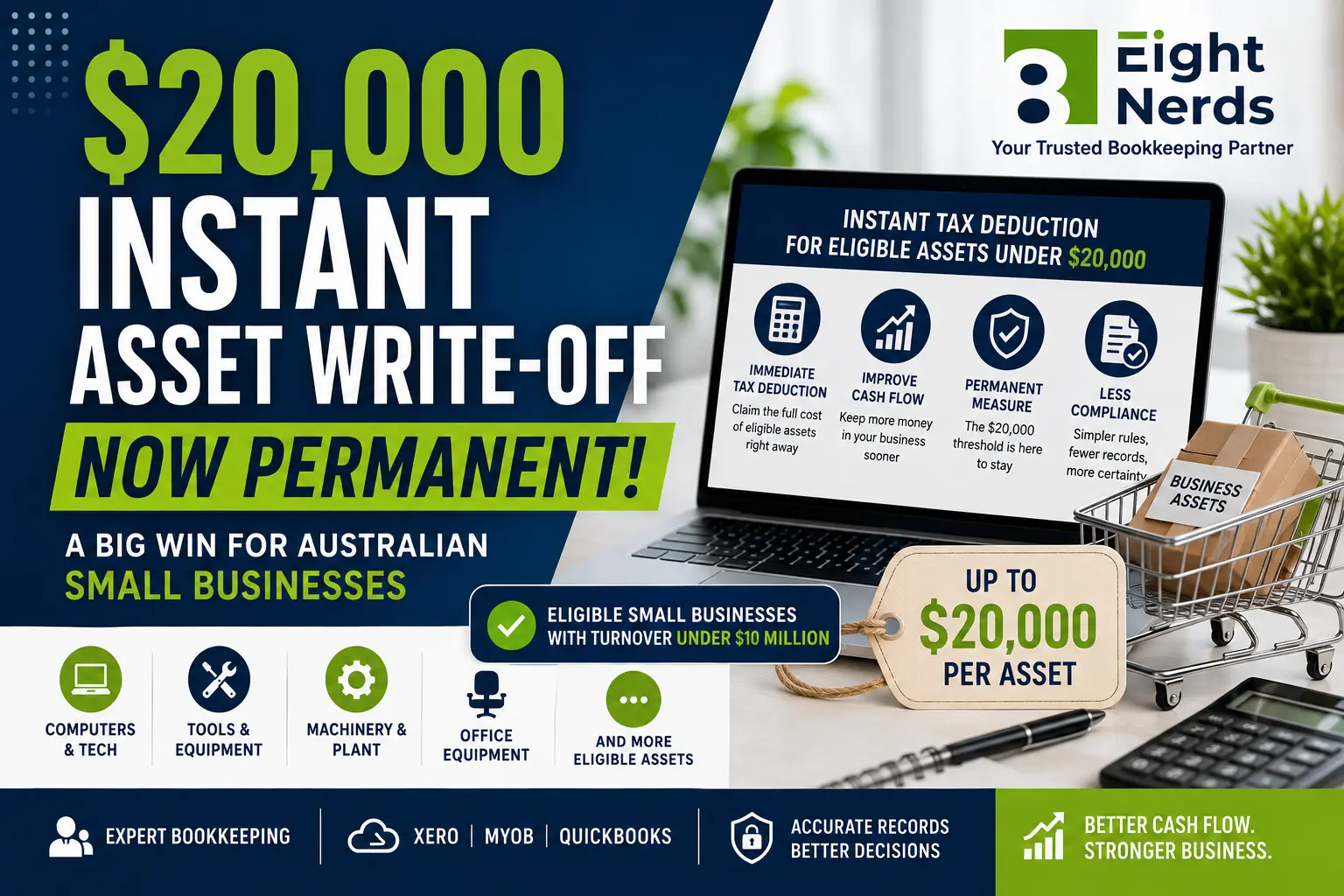
Under the permanent measure, eligible small businesses with aggregated annual turnover of less than $10 million can immediately deduct the full cost of eligible assets costing less than $20,000. The $20,000 threshold applies on a per-asset basis, meaning an eligible business can potentially claim multiple qualifying assets during the same financial year.
For business owners, this is more than simply a tax deduction. It can make it easier to invest in equipment and technology while potentially improving cash flow and reducing the administrative burden associated with depreciation.
What Is the $20,000 Instant Asset Write-Off?
The Instant Asset Write-Off is a tax measure that allows eligible small businesses to immediately deduct the business-use portion of the cost of qualifying depreciating assets, rather than claiming the deduction gradually over several years.
From 1 July 2026, the $20,000 threshold has been made permanent for eligible small businesses. Businesses with aggregated annual turnover below $10 million can immediately deduct eligible assets costing less than $20,000. The threshold applies separately to each eligible asset, so businesses are not restricted to purchasing only one qualifying asset during a financial year.
For example, an eligible business could potentially purchase several qualifying assets during the year and apply the instant deduction to each asset, provided each asset meets the relevant requirements.
The measure provides small businesses with greater certainty when planning investments and can simplify the depreciation treatment of qualifying assets.
Who Can Use the $20,000 Instant Asset Write-Off?
The $20,000 Instant Asset Write-Off is designed for eligible small businesses. To qualify, a business generally needs to meet the applicable turnover requirement and use the relevant asset for a taxable business purpose.
The permanent measure applies to businesses with aggregated annual turnover of less than $10 million.
Before claiming an asset, businesses should consider:
- Whether the business meets the turnover eligibility requirements.
- Whether the asset is an eligible depreciating asset.
- Whether the asset is being used for a taxable business purpose.
- Whether the asset cost is below the $20,000 threshold.
- Whether the business-use portion has been correctly calculated.
- Whether the asset has been installed or first used as required.
- Whether appropriate purchase and usage records have been retained.
Because tax circumstances can differ between businesses, business owners should confirm their eligibility and specific deduction requirements before making a claim.
What Can Businesses Claim Under the Instant Asset Write-Off?
The types of assets that may qualify depend on the relevant tax rules and how the asset is used by the business. In practical terms, the measure can be particularly useful for businesses investing in everyday tools, technology, equipment, and machinery.
Examples may include:
- Computers and laptops
- Business technology
- Tools and equipment
- Office equipment
- Certain machinery
- Equipment used by trades and service businesses
- Other eligible depreciating business assets
The Government has highlighted examples such as tools for tradies, computers for professional services businesses, and machinery for local manufacturers.
However, not every asset automatically qualifies. Businesses should check the applicable eligibility requirements rather than assuming that every purchase below $20,000 can be immediately deducted.
How Does the $20,000 Instant Asset Write-Off Work?
One of the most important features of the $20,000 Instant Asset Write-Off is that the threshold applies on a per-asset basis.
This means an eligible business could potentially purchase multiple qualifying assets during a financial year and claim an immediate deduction for each qualifying asset.
For example, imagine an eligible business purchases:
- A computer for $4,000
- Business equipment for $8,000
- Tools for $6,000
- Office equipment for $3,000
If each asset meets the eligibility requirements, each individual asset can potentially be considered separately because the $20,000 threshold is applied per asset.
This provides greater flexibility for businesses that need to make several smaller investments rather than one large purchase.
What Happens If an Asset Costs $20,000 or More?
The $20,000 threshold is important. Assets costing $20,000 or more are not eligible for the immediate deduction under this particular threshold.
However, eligible small businesses may be able to place assets costing $20,000 or more into the small business simplified depreciation pool and claim deductions under the applicable depreciation rules.
This means businesses should not assume that an asset above $20,000 receives no tax benefit. Instead, a different depreciation treatment may apply depending on the business and asset.
How the Instant Asset Write-Off Can Help Small Businesses
The permanent $20,000 Instant Asset Write-Off can provide several potential benefits for Australian small businesses. One of the biggest advantages is greater certainty when planning business investments.
Potential benefits include:
- Improved cash flow: Immediate deductions can potentially reduce taxable income for the relevant year.
- Greater investment confidence: Businesses can plan purchases knowing the $20,000 threshold is permanent.
- Reduced administrative work: The measure can simplify depreciation treatment for eligible assets.
- Business growth: Equipment and technology investments can help businesses improve productivity.
- Simpler record keeping: Eligible purchases can be treated under the relevant immediate deduction rules rather than depreciated individually over multiple years.
For businesses planning equipment or technology purchases, understanding the rules can help them make more informed financial decisions.
Why Accurate Bookkeeping Matters for the Instant Asset Write-Off
Although the Instant Asset Write-Off can simplify the treatment of eligible assets, businesses still need accurate financial records. Every purchase should be properly recorded and supported by appropriate documentation.
This is where professional bookkeeping can make a significant difference.
Businesses should maintain records such as:
- Purchase invoices
- Receipts
- Asset descriptions
- Purchase dates
- Amount paid
- Business-use percentage
- Financing information, where relevant
- Asset installation or first-use details
- Supporting accounting records
Accurate bookkeeping makes it easier to identify eligible business purchases and provide the information required when preparing financial statements and tax returns.
Using accounting platforms such as Xero, MYOB, or QuickBooks can also help businesses organise transactions, track expenses, and maintain clearer financial records.
Common Instant Asset Write-Off Mistakes Businesses Should Avoid
While the $20,000 Instant Asset Write-Off can be valuable, businesses should avoid treating every purchase below $20,000 as automatically deductible.
Common mistakes include:
- Assuming every asset under $20,000 qualifies.
- Forgetting to consider private or non-business use.
- Failing to retain purchase documentation.
- Incorrectly recording the asset in accounting software.
- Applying the threshold to total annual purchases instead of considering each asset separately.
- Ignoring the rules that apply to assets costing $20,000 or more.
- Claiming deductions without checking eligibility requirements.
Maintaining accurate bookkeeping and seeking professional tax advice when necessary can help reduce these risks.
How Eight Nerds Can Help with Bookkeeping and Asset Records
At Eight Nerds, we help Australian businesses maintain accurate and organised financial records so they can make better financial decisions and manage their bookkeeping more efficiently.
Our team works with leading accounting platforms including Xero, MYOB, and QuickBooks, helping businesses manage transactions, expenses, reconciliations, financial records, and reporting.
For businesses taking advantage of the $20,000 Instant Asset Write-Off, accurate bookkeeping is particularly important because asset purchases need to be correctly recorded and supported by appropriate documentation.
Our bookkeeping support includes:
- Transaction recording
- Bank reconciliation
- Expense tracking
- Asset record management
- Financial reporting
- BAS preparation support
- Accounts payable and receivable
- Xero, MYOB, and QuickBooks support
- Ongoing bookkeeping assistance
By keeping financial records organised throughout the year, businesses can make tax and financial reporting processes more efficient.
How can Eight Nerds be helpful ?
The $20,000 Instant Asset Write-Off 2026 provides eligible Australian small businesses with greater certainty when investing in tools, technology, equipment, and other qualifying assets. With the measure now permanent, businesses can plan eligible purchases with greater confidence while potentially improving cash flow and reducing some compliance costs.
However, the tax treatment of an asset depends on the specific circumstances and applicable rules. Businesses should maintain accurate records, correctly identify eligible assets, and ensure deductions are reported appropriately.
At Eight Nerds, we support Australian businesses with professional bookkeeping and financial record management using Xero, MYOB, and QuickBooks. Our team helps keep your financial records organised so you have clearer information when making investment, bookkeeping, and tax-related decisions.
This article provides general information only and should not be treated as individual tax advice. Businesses should confirm their specific eligibility and deduction treatment with the Australian Taxation Office or a qualified tax professional.

All Categories
Recent Posts

Sydney’s Top Bookkeeping Agency | Complete Guide for Australian Businesses

What Does a Top Bookkeeping Firm in Australia Actually Do?

Monthly PAYG Instalments in Australia: What Businesses Need to Know in 2026