

Buying an established business can be an attractive way to enter a market, acquire an existing customer base or expand your current operations. However, before agreeing to a purchase price, it is important to understand what the business is actually worth, how reliably it generates profit and whether any hidden financial problems could affect its future performance. This is where financial due diligence becomes essential.
What is this? Why is it super important before buying an existing brand or business? Financial due diligence is the process of examining a business’s financial records, earnings, expenses, assets, liabilities and cash flow before completing an acquisition. It helps a potential buyer check whether the financial information provided by the seller reflects the actual condition of the business. Rather than relying entirely on sales figures or reported profits, the buyer investigates how those numbers have been generated, whether they are supported by reliable records and what risks may affect the business after the purchase.
For buyers in Australia, this process is particularly important when considering an established company with existing employees, supplier agreements, customer contracts, outstanding invoices or tax obligations. A business may look profitable in its sales presentation while having weak cash flow, rising costs or financial commitments that are not immediately obvious.
A careful review helps buyers ask the right questions before making a major financial commitment. It can reveal areas that need further investigation, support a more informed valuation and provide a stronger basis for negotiating the purchase. Most importantly, financial due diligence helps you understand what you are buying rather than discovering significant financial problems after the deal is complete.
The Financial Story Behind the Seller’s Figures
When a business goes up for sale, the seller may present revenue figures, profit statements and growth projections to demonstrate its potential. These numbers are useful, but they should be treated as the starting point for investigation rather than the final answer. A business can report increasing revenue while its operating expenses are rising even faster. Profit may also have been affected by one-off transactions, unusual expenses or income that may not continue after the acquisition. If the buyer accepts the headline figures without examining the underlying records, the purchase price may be based on an incomplete understanding of financial performance.
Financial due diligence involves checking how the reported results connect with actual business activity. Sales should be supported by appropriate records, expenses should reflect the costs of operating the business, and reported earnings should be consistent with the supporting financial information.
For example, a company may have generated strong revenue during a particular year because it received a large one-time contract. If that contract is unlikely to continue, the buyer needs to understand how its absence could affect future earnings. Similarly, reported profit may appear higher because certain expenses have been deferred or have not yet been fully recorded.
The objective is not to assume that the seller’s figures are incorrect. It is to independently assess whether those figures provide a reliable picture of the business being purchased.
Look Beyond One Year of Financial Results
One profitable year does not necessarily establish that a business is financially stable. A more useful picture emerges when financial performance is examined over several periods.
For an established Australian business, reviewing approximately three to five years of financial information, where available and relevant, can help identify trends that may not be visible in a single year’s accounts. The Australian Government’s guide to buying an existing business recommends examining several years of financial records as part of due diligence.
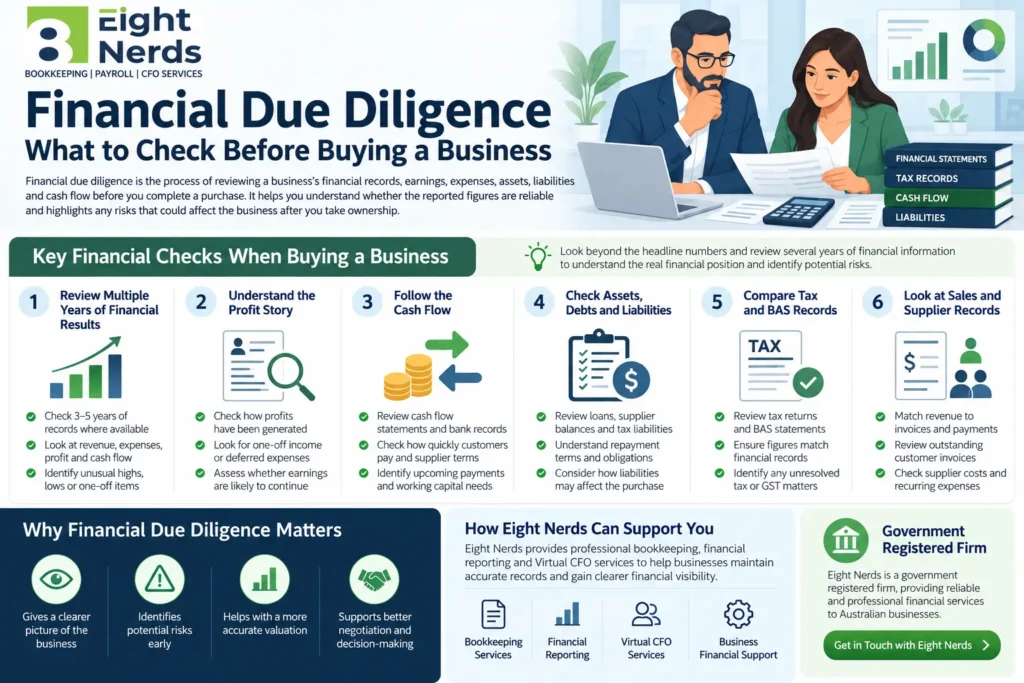
The review should consider revenue growth, gross profit margins, operating expenses, net profit and cash flow. It should also investigate significant variations between periods. If revenue has increased but profitability has declined, the buyer needs to understand why. If earnings fluctuate substantially from year to year, it is worth examining whether the business depends on seasonal demand, a small number of large customers or unusual market conditions.
Financial statements should also be compared with relevant supporting information, including sales records, tax returns, Business Activity Statements and accounts receivable and payable reports. Differences do not automatically indicate wrongdoing, but they should be understood before the buyer relies on the reported results.
A consistent financial history gives the buyer a more realistic basis for assessing the business’s earning capacity and identifying questions that need to be resolved before completion.
Check Whether Reported Profits Reflect the Business’s Real Performance
Profit is one of the most important considerations when buying a business, but not every profit figure tells the same story. A profit and loss statement may show that a company has earned a healthy amount during the year, yet the final result could include unusual income or exclude costs that the new owner will need to bear. If the seller has been performing unpaid work, for example, the buyer may need to consider the cost of employing someone to carry out those responsibilities after the acquisition.
The same issue can arise when expenses have been unusually low because the owner handled several functions personally, essential maintenance was postponed or certain costs were shared with another business.
Financial due diligence examines these factors to develop a more realistic understanding of ongoing profitability. Where adjustments to reported earnings are proposed, each adjustment should be supported by evidence and assessed carefully rather than accepted automatically.
This matters when determining what price the business can reasonably justify. A company generating dependable profits from recurring operations may represent a different financial proposition from one whose earnings depend heavily on temporary circumstances.
The purpose is to understand the earnings the business is likely to sustain under the buyer’s ownership, rather than simply accepting the profit shown in the latest report.
Follow the Cash Flow, Not Just the Profit
A business can report profits while experiencing financial pressure because its customers have not paid their invoices, inventory has absorbed cash or major supplier payments are approaching.
For this reason, reviewing cash flow is an important part of financial due diligence. The buyer needs to understand how money enters and leaves the business, how quickly customers pay and whether operating activities generate enough cash to support day-to-day commitments.
Start by examining cash flow statements, bank records and outstanding customer invoices. Consider whether the business depends heavily on a small number of customers paying on time or whether significant amounts remain outstanding for extended periods.
Supplier payments and other commitments also deserve attention. A business may have substantial upcoming expenses even when its reported profit appears healthy. Loans, lease commitments and planned capital expenditure can further affect how much cash remains available after the purchase.
Understanding these factors helps the buyer assess whether the business will need additional working capital after acquisition. Without this assessment, the purchase price may be only one part of the total funding required to keep the business operating.
Outstanding Debts and Liabilities Need a Closer Look
The financial position of a business cannot be assessed by looking at its assets and revenue alone. Existing liabilities may affect the buyer’s financial exposure, depending on the transaction structure and the terms of the purchase.
Reviewing the balance sheet helps identify recorded loans, supplier balances, tax-related liabilities and other obligations. Supporting documents may be needed to understand repayment terms, payment deadlines and whether the recorded balances are complete.
It is also important to examine outstanding accounts payable, customer deposits, refunds, warranties and contractual commitments where relevant. Some obligations may not be immediately obvious from the headline profit figures, yet they can still affect the future cost of operating the business.
The treatment of liabilities can differ between an asset purchase and a share purchase. In a share acquisition, the buyer is acquiring ownership of the existing company and must consider its historical position, including potential tax-related risks. The Australian Taxation Office explains that tax due diligence can help identify tax risks associated with acquiring an existing business or entity.
This is why financial due diligence should be coordinated with appropriate legal and tax advice. The financial review can identify issues, but the purchase agreement and transaction structure determine how specific risks are addressed.
Make Sure the Tax and GST Records Support the Numbers
Australian businesses have financial and tax reporting obligations that can influence the accuracy of their records. When buying a business, it is important to understand whether its reported financial performance is consistent with the underlying tax and GST information.
Depending on the business, the review may include tax returns, BAS records, sales documentation and information supporting relevant expenses. These records can help establish whether reported turnover, expenses and GST-related figures are consistent across different reporting periods.
Differences between accounting records and tax information should be investigated. They may reflect legitimate adjustments or timing differences, but they should not be ignored simply because the business appears profitable.
The buyer should also understand whether any unresolved tax matters, amended statements or potential compliance issues could affect the acquisition. The appropriate scope depends on the business, its structure and the risks involved.
A qualified accountant or registered tax professional can help interpret these matters and determine whether further investigation is needed. This is particularly important where the buyer intends to acquire shares in an existing company rather than only selected business assets.
Examine the Records Behind Customer Sales and Supplier Costs
Reliable financial results depend on the quality of the records behind them. During an acquisition, it is worth checking whether sales, customer payments and supplier expenses can be traced through the accounting system to supporting documentation.
For example, reported revenue should be consistent with sales invoices and other appropriate records. Customer payments should be accounted for correctly, while outstanding balances need to be reviewed to determine whether they are likely to be collected. An apparently strong sales figure may be less valuable if a significant portion comes from overdue or disputed invoices.
Supplier costs need similar attention. The buyer should understand whether major expenses have been recorded correctly, whether supplier balances agree with available statements and whether there are recurring costs that have not been fully reflected in the financial reports.
Poorly maintained bookkeeping can make this investigation difficult. Missing invoices, unreconciled accounts and inconsistent expense categories may prevent the buyer from establishing a reliable picture of the business’s financial position.
When records are incomplete, the problem is not necessarily proof of financial misconduct. However, it increases uncertainty and may require additional investigation before the buyer can comfortably rely on the figures.
Understand What Is Driving the Business’s Profitability
An overall profit figure can hide substantial differences in performance across products, services, customers or locations.
A business may generate most of its revenue from a small number of customers. Another may have several profitable service lines but rely on one area that produces very little return after its direct costs are considered. If the buyer does not understand these differences, the acquisition may carry greater risk than the total profit figure suggests.
Financial due diligence should therefore examine the factors that drive revenue and margins. Depending on the business model, that may involve reviewing customer concentration, product costs, service delivery expenses, payroll, inventory and the performance of individual locations or business units.
The review should also consider whether key commercial relationships are likely to continue after the current owner exits. If a large customer has a personal relationship with the seller rather than a long-term contractual commitment with the business, the buyer should understand what this could mean for future revenue.
This analysis helps distinguish sustainable profitability from results that depend on a limited number of customers, unusually favourable arrangements or circumstances that may change following the sale.
Identify Warning Signs Before They Become Your Problem
Certain findings deserve particular attention during a business acquisition. These include inconsistent revenue figures, repeated reconciliation differences, unexplained expense adjustments, large overdue customer balances and financial reports that cannot be supported by source documents.
Rapid revenue growth alongside declining margins can also warrant further investigation. It may indicate rising costs, pressure on pricing or changes in the business’s customer mix. Similarly, significant differences between financial reports and bank activity should be explained before the buyer proceeds.
The important point is to investigate these issues rather than immediately assuming the worst or overlooking them because the deal appears attractive.
A documented financial review makes it easier to raise questions with the seller, request missing information and discuss unresolved matters with professional advisers. Depending on the findings, the buyer may need to reconsider the valuation, negotiate appropriate contractual protections, seek additional advice or decide not to proceed.
Financial due diligence is valuable because it creates an opportunity to address uncertainty before the buyer becomes responsible for operating the business.
How Eight Nerds Can Support Financial Record Review
Reviewing a business’s finances requires organised records and a clear understanding of how its transactions have been recorded. When bookkeeping is incomplete or financial reports are difficult to interpret, it becomes harder to assess performance and investigate potential problems.
Eight Nerds provides professional bookkeeping, financial reporting and Virtual CFO support for Australian businesses. Depending on the engagement, this support can help organise financial records, review account reconciliations, examine revenue and expense information and improve the visibility of cash flow and profitability.
For prospective buyers, reliable financial information can make discussions with their accountant and other professional advisers more productive. It can help bring inconsistencies to attention and provide a clearer basis for examining the figures presented during a potential acquisition.
However, a business acquisition may involve financial, tax, legal and commercial risks that extend beyond routine bookkeeping. Formal acquisition due diligence should be scoped with appropriately qualified professionals, including an accountant or tax adviser and a lawyer where required. Eight Nerds’ bookkeeping and financial support can contribute to the quality and organisation of the information being reviewed, subject to the agreed scope of services.
The objective is to help businesses work with clearer financial records and make decisions based on better information rather than assumptions.
Frequently Asked Questions About Financial Due Diligence
What is financial due diligence when buying a business?
Financial due diligence is the process of reviewing a business’s financial records, earnings, expenses, cash flow, assets and liabilities before completing an acquisition. It helps a buyer assess whether the reported financial position is reliable and identify matters that require further investigation.
How many years of financial records should I review?
The appropriate period depends on the business and the circumstances of the transaction. Reviewing around three to five years of available financial information can help identify performance trends, unusual results and recurring risks. Recent records should also be examined to understand the business’s current position.
Which financial documents are important when buying an Australian business?
Relevant records may include profit and loss statements, balance sheets, cash flow statements, tax returns, BAS records, sales records, accounts receivable and payable reports, bank statements and loan documents. The precise requirements depend on the structure and nature of the acquisition.
Can a business be profitable but still be risky to buy?
Yes. A business may show profits while depending on a small number of customers, carrying significant liabilities, experiencing weak cash flow or having incomplete financial records. Looking beyond headline profit helps buyers understand these risks before committing.
Is financial due diligence the same as a financial audit?
No. Financial due diligence is performed to investigate a potential acquisition and understand the risks relevant to the buyer. A financial audit has a different purpose, scope and professional framework. A due diligence review does not automatically replace an audit or other required assurance work.
Can Eight Nerds help prepare records for an acquisition review?
Eight Nerds can discuss bookkeeping, account reconciliation and financial reporting support to help organise the information needed for a review. The precise scope should be agreed in advance, and formal tax, legal or acquisition assurance work should be handled by the appropriate qualified professionals.
Make Your Next Business Acquisition an Informed Decision
Buying an established business involves more than agreeing on a price or assessing its reputation. The financial records need to support the story being presented, the cash flow should be understood, liabilities need to be investigated and the factors driving profitability should be clear.
A structured financial due diligence process helps buyers identify gaps, ask better questions and understand the financial commitments they may take on. It can also provide a more realistic basis for valuation and negotiations before a purchase agreement is finalised.
Eight Nerds supports Australian businesses with bookkeeping, financial reporting and Virtual CFO services that help maintain organised financial records and improve visibility into business performance.
Before committing to a business purchase, make sure you understand the numbers behind the opportunity. Contact Eight Nerds to discuss bookkeeping and financial reporting support for your business.