
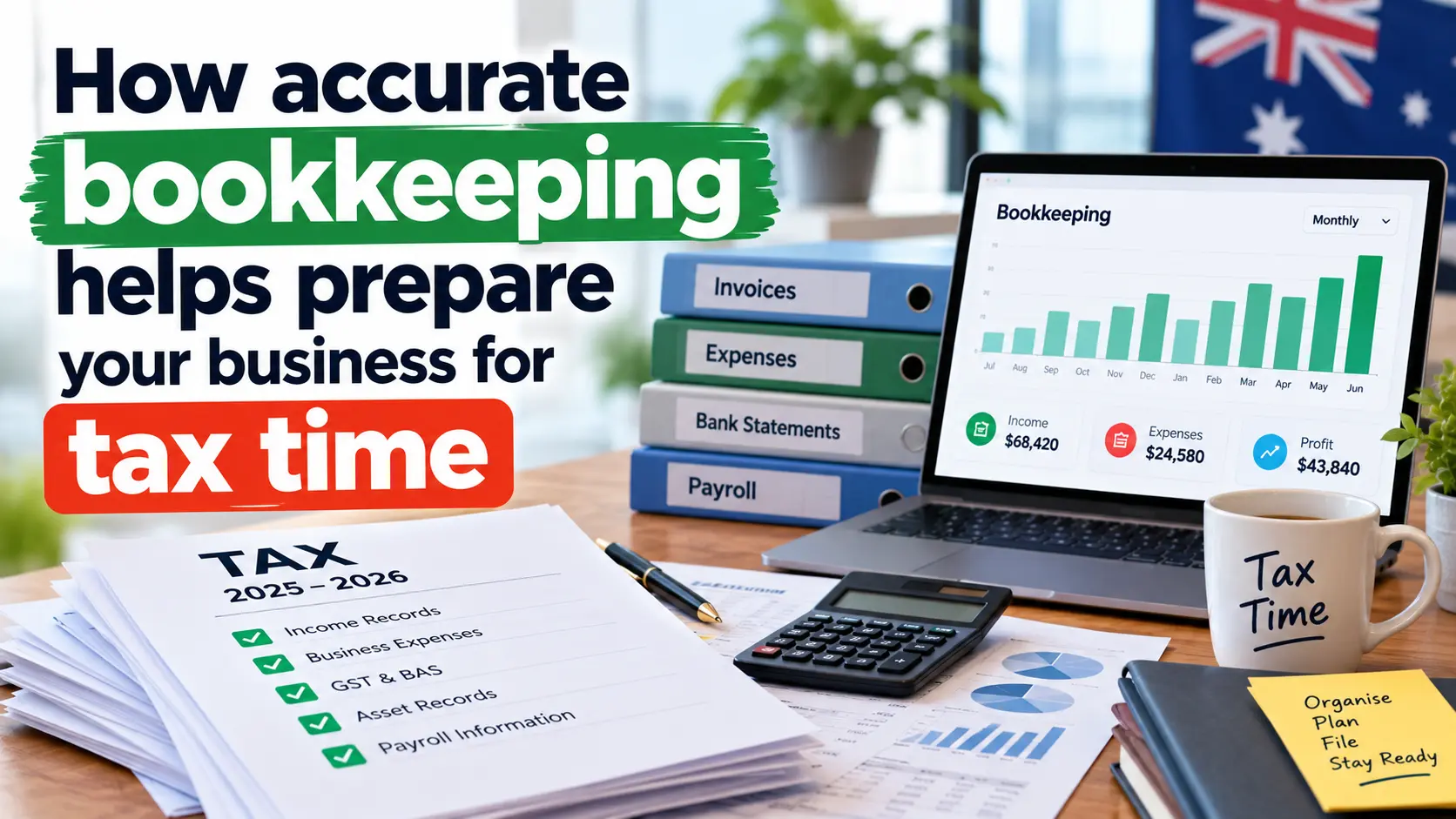
How accurate bookkeeping helps prepare your business for tax time?
Tax time tends to become stressful when a business owner is trying to put months of financial information together at the last minute. Receipts are scattered across emails, supplier invoices are sitting in different folders, some transactions have not been reconciled and there may be uncertainty around which expenses were personal and which were genuinely business-related. By the time everything reaches the accountant, a simple tax return can turn into a long process of finding missing information and fixing old bookkeeping errors. Accurate bookkeeping throughout the year changes that experience.
When your financial records are updated consistently, tax-related information is easier to find, review and organise. It also gives you a clearer understanding of the numbers behind your business instead of treating tax time as a once-a-year clean-up exercise.
For Australian businesses, proper record keeping is part of meeting tax and other business obligations. Business.gov.au advises businesses to keep records covering income, expenses, bank transactions, GST where applicable, assets, employees and other relevant transactions. Most business records generally need to be kept for five years, although some records have longer retention requirements.
Here is how accurate bookkeeping can make the tax-time process more manageable.
Accurate Bookkeeping Keep income records in order
The starting point for preparing business tax information is knowing exactly what the business earned.
Sales may come from different sources, payment platforms, bank transfers, online stores or other systems. When these transactions are recorded properly, it becomes much easier to establish the business’s income for the relevant financial period.
Regular bookkeeping also reduces the chance of overlooking transactions or recording the same income twice.
This is especially useful for businesses that have a high number of daily transactions. Instead of spending days reconstructing sales at the end of the financial year, the information is already being maintained as the business operates.
Accurate records can also make it easier for your tax professional to review the information before preparing or lodging the relevant returns.
Accurate bookkkeeping Make business expenses easier to substantiate
Business owners often focus on keeping receipts, but a receipt on its own may not always tell the whole story.
The Australian Government notes that records supporting business deductions need to substantiate the transaction and explain its business relevance. Depending on the expense, additional information may be important to establish how it relates to the business.
A good bookkeeping process helps organise those expenses throughout the year.
For example, instead of having hundreds of receipts sitting in an inbox, transactions can be recorded under appropriate categories such as advertising, software, office costs, travel or professional services.
This creates a much clearer trail of how the business spent its money.
Reduce the last-minute tax-time rush
One of the biggest advantages of accurate bookkeeping is surprisingly simple: less chasing.
When accounts are maintained monthly, there is less need to ask questions such as:
“Where is this invoice?”
“What was this payment for?”
“Was this expense personal or business-related?”
“Why doesn’t the bank balance match the accounting software?”
These questions can still come up, but they are easier to resolve when the transaction is recent and the supporting information is readily available.
By contrast, trying to remember the purpose of a payment from several months ago can take considerably more time.
Reconcile your accounts regularly
Bank reconciliation is an important part of maintaining reliable bookkeeping records.
It involves comparing the transactions recorded in the accounting system with the transactions shown by the bank or other financial accounts.
Regular reconciliation can reveal missing transactions, duplicate entries, incorrect amounts and other discrepancies that may affect financial reports.
Finding those issues during the year is generally more practical than discovering a long list of unexplained differences just before tax information needs to be finalised.
It also helps ensure that the financial reports being reviewed by the business owner are based on records that have been properly checked.
Keep GST and BAS information organised by accurate Bookkkeeping
For businesses registered for GST, bookkeeping also plays an important role in maintaining the information needed for BAS reporting.
The ATO explains that GST-registered businesses need to account for GST collected from customers and GST credits on eligible purchases through their BAS.
Correct transaction coding therefore matters.
If GST treatment is incorrectly recorded across a large number of transactions, correcting the records later can become time-consuming. Keeping the books updated and reviewing transactions regularly creates a more organised foundation for BAS preparation.
Where a registered BAS or tax agent is responsible for lodgment, accurate bookkeeping can also make it easier for them to review the underlying records.
Have a clearer picture of deductible expenses
Tax deductions should not be approached as a guessing exercise.
Business owners need appropriate records to support expenses they claim, and the rules can depend on the nature of the expense and the circumstances of the business.
Good bookkeeping does not mean automatically claiming every expense that appears in the bank account. Instead, it creates an organised record from which eligible expenses can be reviewed properly.
This distinction is important because personal expenditure and business expenditure should not simply be mixed together.
Maintaining separate business records and clearly categorising transactions can make this review considerably easier.
Track assets and larger purchases properly
Equipment, vehicles, computers, machinery and other business assets can require different treatment from ordinary day-to-day expenses.
Keeping proper records of when an asset was purchased, how much it cost and how it is used gives your accountant or tax professional the information they need to determine the appropriate tax treatment.
Business.gov.au specifically recommends keeping records of assets that have been bought or sold, as well as expenditure related to improving those assets. Such information can be relevant when calculating depreciation deductions and, where applicable, capital gains tax.
This is another reason why accurate bookkeeping should happen throughout the year rather than being left until June or tax-return preparation time.
Make payroll records easier to manage
Payroll introduces another layer of financial information into a business.
Wages, superannuation, employee records and related transactions need to be maintained accurately, and payroll information may feed into other reporting and compliance processes.
Keeping payroll records organised alongside the rest of the business’s financial information can make year-end reconciliation easier and reduce the amount of information that needs to be reconstructed later.
For businesses with employees, this becomes increasingly important as the workforce grows.
Identify errors before they become bigger problems
A bookkeeping error is not always obvious.
An expense might be placed in the wrong account. A payment could be duplicated. A customer receipt may not be matched correctly. A supplier invoice could remain unpaid in the records even though it has already been settled.
One small error may appear insignificant, but repeated inconsistencies can distort financial reports.
Monthly bookkeeping gives businesses opportunities to review their records regularly and correct issues before they accumulate.
That is valuable not only for tax preparation but also for everyday business management.
Give your accountant cleaner information
Your accountant can only work with the information available to them.
When financial records are incomplete, the accountant may need additional explanations, documents and transaction details before they can complete their work efficiently.
Accurate bookkeeping creates a cleaner starting point.
A well-organised set of records can include reconciled bank accounts, categorised income and expenses, accounts receivable, accounts payable, payroll information and relevant supporting documents.
This can make the handover between bookkeeping and tax preparation much smoother.
It also means your accountant can spend less time trying to understand basic transaction history and more time addressing the accounting or tax matters that require professional judgement.
Prepare earlier instead of reacting later
Tax preparation becomes considerably easier when there is a process behind it.
Rather than waiting until the end of the financial year, businesses can use monthly bookkeeping to build a complete financial history throughout the year.
A simple monthly routine might include:
- reconciling business bank accounts
- recording all income and expenses
- checking outstanding invoices
- reviewing supplier bills
- keeping supporting documents organised
- reviewing GST coding where applicable
- checking payroll-related records
- reviewing the profit and loss statement
- investigating unusual transactions
The exact process will vary depending on the business structure, accounting system and industry.
The important part is consistency.
Accurate bookkeeping is about more than tax
It is tempting to think about bookkeeping as something a business needs only because tax returns and BAS exist.
In reality, accurate financial records can be useful throughout the year.
The same information used to prepare for tax time can help a business owner understand profitability, monitor cash flow, control expenses and plan future spending. Business.gov.au also notes that good record keeping supports business decisions and cash-flow management.
So, rather than viewing bookkeeping as an annual administrative task, businesses can treat it as an ongoing source of financial information.
8 NERDS explains need for accurate Bookkeeping support
Tax time does not have to mean searching through old emails, chasing missing invoices and trying to remember transactions from months ago.
When bookkeeping is accurate and maintained regularly, most of the groundwork is already done.
Income is recorded, expenses are organised, accounts are reconciled, supporting documents are easier to locate and financial reports are available for review. That can make the tax-preparation process more structured and give your accountant or tax professional a much cleaner set of records to work with.
For growing businesses, professional bookkeeping services can take much of this ongoing administrative work off the owner’s plate while keeping financial information organised throughout the year.
At 8Nerds, bookkeeping, payroll and cash-flow support can be structured around the needs of your business, helping you maintain financial records throughout the year rather than scrambling to organise everything when tax time arrives.
Great bookkeeping is not simply about being ready for tax time. It is about keeping your business financially organised every month.

All Categories
Recent Posts

Bookkeeper Services in Sydney | How to Choose the Right Bookkeeper

How accurate bookkeeping helps prepare your business for tax time?

How Monthly Bookkeeping Services Can Help Business Owners Make Better Financial Decisions