
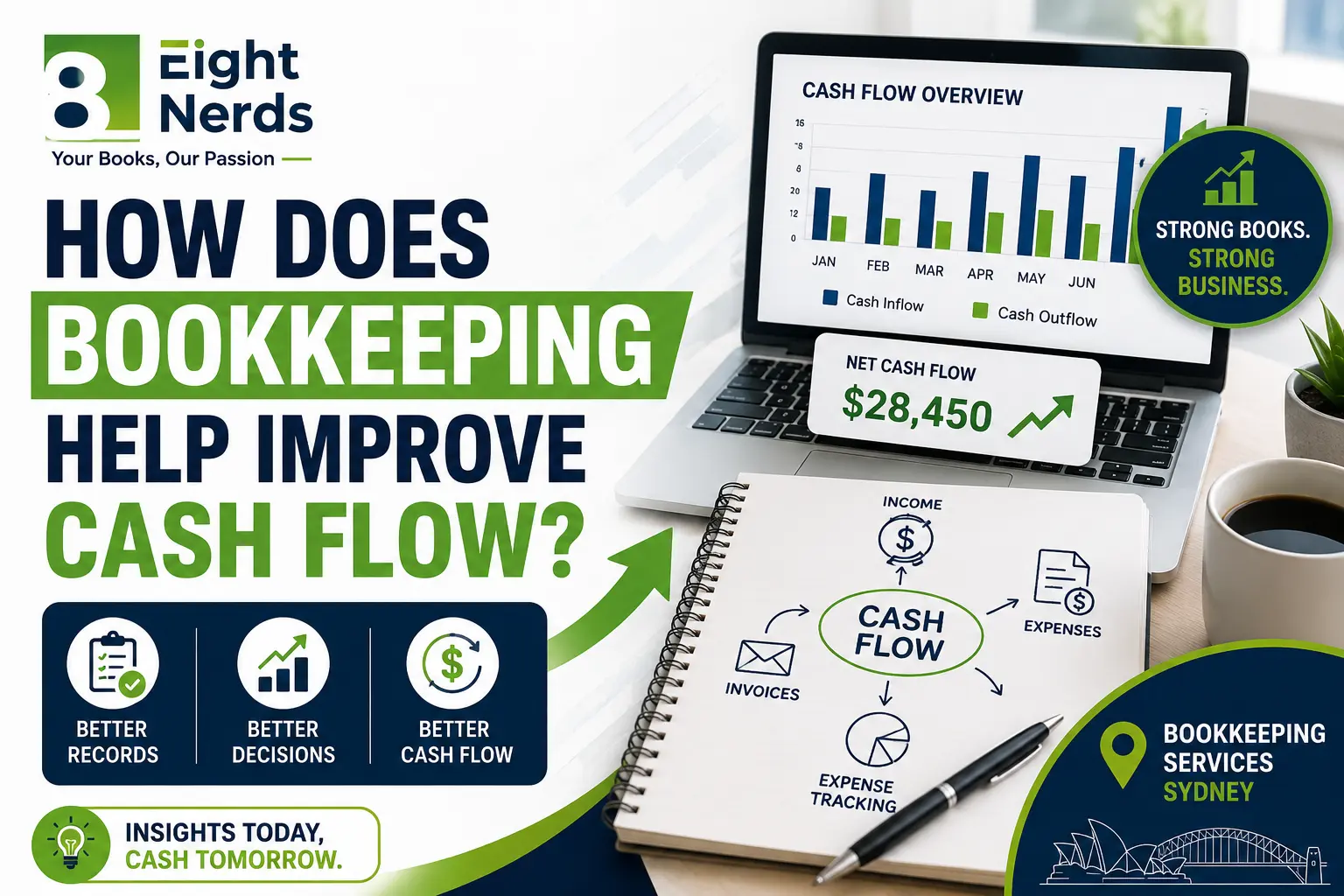
How Does Bookkeeping Help Improve Cash Flow?
Cash flow is one of the clearest indicators of a business’s financial health. You can have strong sales and still struggle to pay suppliers, wages, tax bills, or other expenses if money is not coming in at the right time. This is where accurate bookkeeping becomes important. So, how does bookkeeping help improve cash flow?
Good bookkeeping gives business owners an accurate view of money coming in, money going out, outstanding invoices, upcoming expenses, and overall financial performance. With this information available regularly, businesses can identify potential cash shortages earlier and make better financial decisions.
For Australian businesses, maintaining accurate financial records is also an important part of managing tax and other business obligations. The Australian Taxation Office explains that regular record keeping and reporting can help businesses manage cash flow, plan for large expenses, and prepare for tax and other obligations.
How Does Bookkeeping Help Improve Cash Flow Management?
Bookkeeping helps improve cash flow by keeping your financial information accurate, organised, and up to date. When transactions are recorded consistently, business owners can see what has already been paid, what is still outstanding, and what expenses are coming up.
Without current bookkeeping records, it can be difficult to know whether your business actually has enough available cash to cover upcoming commitments.
Effective bookkeeping can help you:
- Track income and business expenses
- Monitor unpaid customer invoices
- Identify unnecessary or increasing expenses
- Reconcile bank transactions
- Understand your current cash position
- Prepare accurate financial reports
- Identify potential cash shortages earlier
- Plan for upcoming tax and business expenses
Australian Government guidance also recommends keeping good financial records and regularly reviewing cash flow to identify problems early and support better decision-making.
How Bookkeeping Helps Improve Cash Flow by Tracking Outstanding Invoices
One of the simplest ways bookkeeping helps improve cash flow is by helping businesses keep track of money that customers still owe.
A sale does not necessarily mean cash has entered your bank account. If a customer has received an invoice but has not paid it, the business may have revenue on its records but still not have the cash available to pay its own bills.
Regular bookkeeping can help identify:
- Which invoices are overdue
- How much customers currently owe
- How long invoices have been outstanding
- Which customers regularly pay late
- How much cash is expected to come in
Australian Government guidance recommends managing invoicing and debtors to help businesses get paid sooner and prevent bad debts.
This makes accurate bookkeeping particularly useful for businesses that operate on credit terms or regularly have outstanding customer invoices.
How Bookkeeping Helps Improve Cash Flow by Controlling Expenses
Cash flow is not only about getting more money into the business. It is also about understanding where money is going.
Accurate bookkeeping categorises business expenses and makes it easier to identify areas where costs are increasing. For example, a business might discover that software subscriptions, supplier costs, advertising expenses, or vehicle costs have gradually increased without being noticed.
Regular financial records can help business owners ask practical questions such as:
- Which expenses are essential?
- Which costs have increased recently?
- Are we paying for services we no longer use?
- Are supplier costs affecting our margins?
- Can certain payments be negotiated or scheduled differently?
Business.gov.au recommends regularly reviewing costs as part of improving cash flow.
How Bookkeeping Helps Improve Cash Flow Forecasting
Another important way bookkeeping helps improve cash flow is by providing the historical financial information needed for forecasting.
A cash flow forecast estimates how much money is expected to come into and leave the business over a future period. Accurate bookkeeping gives you reliable information about previous sales, expenses, payment patterns, supplier costs, and recurring commitments.
This can help you identify potential shortages before they happen.
For example, your bookkeeping records might show that:
Customer payments are usually received 30 days after invoicing, while wages, rent and supplier payments are due within the next two weeks.
That information can highlight a potential cash gap even when the business is profitable.
The Australian Government recommends using cash flow statements and forecasts to identify potential shortages and plan for future expenses.
Bookkeeping and Cash Flow: Profit Is Not the Same as Cash
One of the most important concepts business owners need to understand is that profit and cash flow are not the same thing.
A business can show a profit on its income statement while still experiencing cash flow pressure. This can happen when customers have not paid their invoices, inventory has absorbed cash, or significant expenses have been paid before expected income arrives.
For example:
| Business situation | Profit | Cash position |
|---|---|---|
| Customer invoice issued but unpaid | May increase | Cash has not arrived |
| Large supplier payment made | May not immediately reflect the same way | Cash decreases |
| Loan received | Does not necessarily represent operating profit | Cash increases |
| Equipment purchased | May be treated differently in accounts | Cash decreases |
Xero’s Australian guidance similarly highlights that a profitable business can still run out of cash when the timing of payments and receipts does not align.
This is why good bookkeeping should not simply focus on recording transactions. It should help business owners understand what those transactions mean for the business’s available cash.
Regular Bookkeeping Helps Improve Cash Flow Visibility
The frequency of bookkeeping can also make a difference.
If your books are only updated occasionally, you may be making business decisions using outdated information. Regular bookkeeping provides a more current picture of your financial position.
Depending on the size and transaction volume of the business, bookkeeping may be performed weekly, fortnightly, or monthly.
Regular bookkeeping can help you:
- Identify overdue invoices sooner
- Spot unusual expenses
- Monitor business performance
- Reconcile bank accounts
- Prepare more reliable financial reports
- Plan upcoming payments
- Identify changes in cash flow trends
The Australian Government recommends keeping good financial records and using digital accounting tools to monitor financial information and cash flow.
Improve Cash Flow Through Better Financial Decisions
Accurate bookkeeping gives business owners the information they need to make decisions based on actual financial data rather than assumptions.
For example, before hiring an employee, purchasing equipment, increasing stock, or opening another location, a business owner needs to understand whether the business can comfortably manage the additional cash requirements.
Good bookkeeping can provide information about:
- Current cash reserves
- Monthly operating expenses
- Outstanding receivables
- Supplier obligations
- Payroll costs
- Tax liabilities
- Historical income and expenses
This financial visibility can help business owners decide when to spend, when to save, and when to delay a major expense.
Can Outsourced Bookkeeping Help Improve Cash Flow?
Yes. Outsourced bookkeeping can help improve cash flow when the service includes regular reconciliations, accurate financial reporting, invoice tracking, expense management, and cash flow monitoring.
Instead of leaving bookkeeping until tax time, businesses can maintain their records throughout the year and use the information to make timely decisions.
A professional bookkeeping service can also work alongside your accountant or tax adviser, ensuring that financial records are organised and ready when they are needed.
For businesses in Sydney, this can be particularly useful when owners want to spend less time managing financial administration and more time focusing on customers, operations, and growth.
What Should You Track to Improve Business Cash Flow?
If your goal is to use bookkeeping to improve cash flow, focus on a few important numbers consistently.
| Cash Flow Metric | Why It Matters |
|---|---|
| Accounts receivable | Shows money customers still owe |
| Accounts payable | Shows upcoming supplier obligations |
| Available cash | Shows current liquidity |
| Monthly expenses | Helps identify spending patterns |
| Payroll costs | Important recurring cash commitment |
| GST and tax obligations | Helps plan for future payments |
| Cash flow forecast | Helps identify future shortages |
Reviewing these figures regularly can give you a much clearer picture of your business’s financial position.
How 8Nerds Can Help Improve Cash Flow Through Bookkeeping
At Eight Nerds, bookkeeping is about more than simply recording transactions. Our goal is to help businesses maintain organised financial records that provide greater visibility into their cash position and business performance.
Led by Tapish Arora, Founder of 8Nerds, the team brings more than 12 years of accounting experience, including experience with prestigious CA firms and Top 10 accounting firms in Australia.
Our bookkeeping support can help businesses with:
- Regular bookkeeping and reconciliations
- Financial reporting
- Payroll management
- BAS-related bookkeeping
- Cash flow visibility
- Accounts receivable and payable
- Cloud accounting systems
For Sydney businesses looking for professional bookkeeping services, keeping financial records accurate and up to date can be an important first step towards stronger cash flow management.
Frequently Asked Questions About How Bookkeeping Helps Improve Cash Flow
Does bookkeeping really help improve cash flow?
Yes. Accurate bookkeeping helps businesses understand their income, expenses, outstanding invoices, upcoming payments, and current financial position. This information can help identify cash flow problems earlier and support better decisions.
How does bookkeeping improve cash flow?
Bookkeeping can improve cash flow by helping businesses track unpaid invoices, monitor expenses, reconcile accounts, prepare cash flow forecasts, and plan upcoming payments.
Can a profitable business still have cash flow problems?
Yes. A business can be profitable but still experience cash shortages if customers pay late, large expenses are due before revenue is received, or cash is tied up in inventory or assets.
How often should bookkeeping be updated?
The right frequency depends on transaction volume and business needs. Businesses with frequent transactions or tight cash flow may benefit from more frequent bookkeeping, while others may use a monthly schedule.
Can a bookkeeper help with cash flow forecasting?
A bookkeeper can help maintain the accurate financial records needed for cash flow forecasting and reporting. Business owners can then use these reports to plan upcoming expenses, payments, and potential cash shortages.
How Bookkeeping Helps Improve Cash Flow
So, how does bookkeeping help improve cash flow? The answer goes beyond simply keeping financial records organised.
Accurate bookkeeping helps businesses understand where their money is coming from, where it is going, what customers owe, which expenses are due, and whether there could be a cash shortage in the future.
When financial records are kept up to date, business owners have better information to manage expenses, collect outstanding payments, forecast cash flow, and make confident financial decisions.
For Australian businesses, good bookkeeping is therefore not just an administrative task. It can become an important part of effective cash flow management and long-term financial planning.

All Categories
Recent Posts


What is Business Expense Management ? How Australian Businesses Can Control Rising Costs