
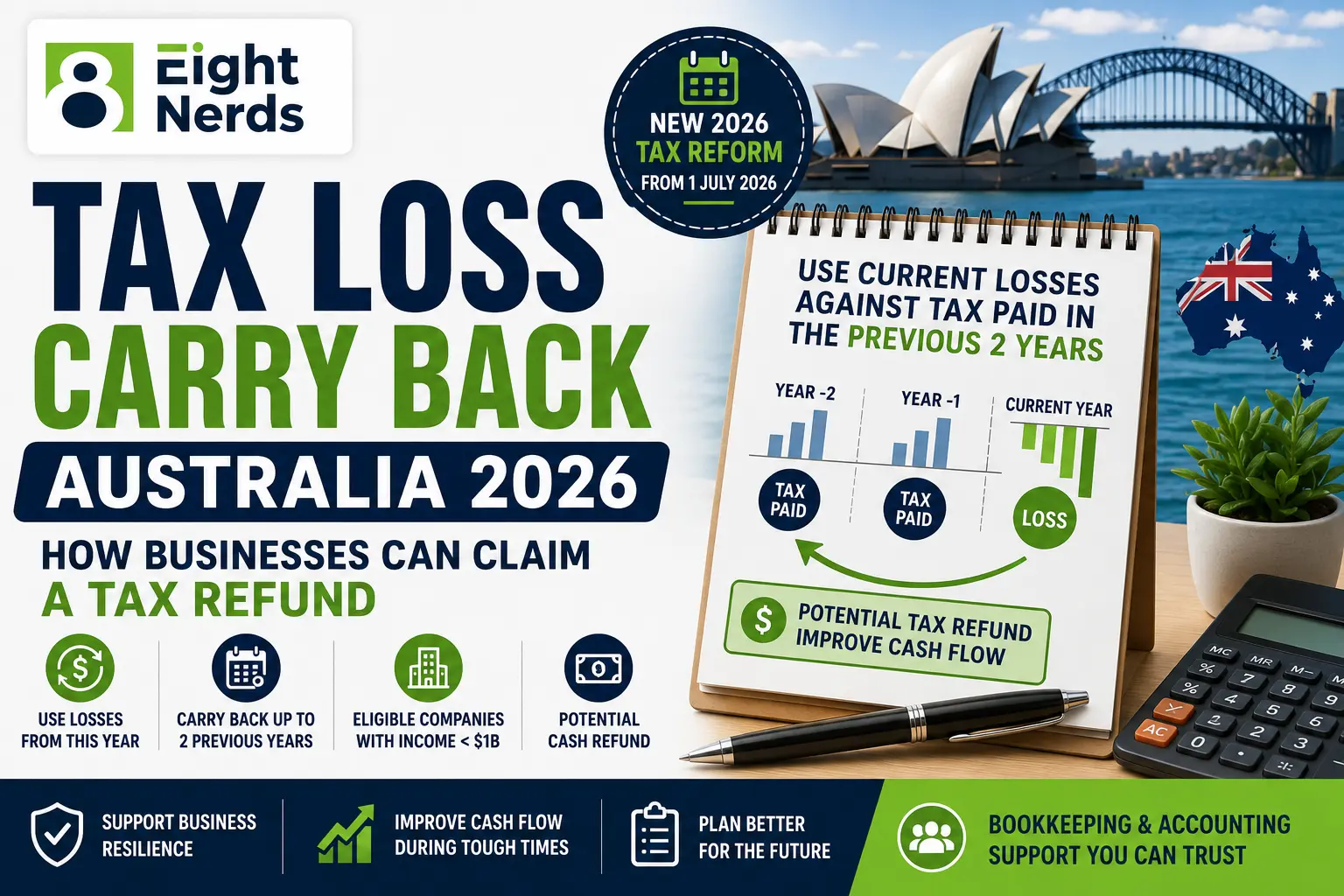
Australian businesses can face profitable years followed by periods of lower sales, higher operating costs, major investments, or unexpected economic challenges. When a company makes a tax loss after previously paying income tax, the loss can become an important tax asset. A new Australian tax reform provides eligible companies with a way to use certain current-year losses against tax paid in earlier years. The Tax Loss Carry Back Australia 2026 rules have been reintroduced for tax years starting on or after 1 July 2026.
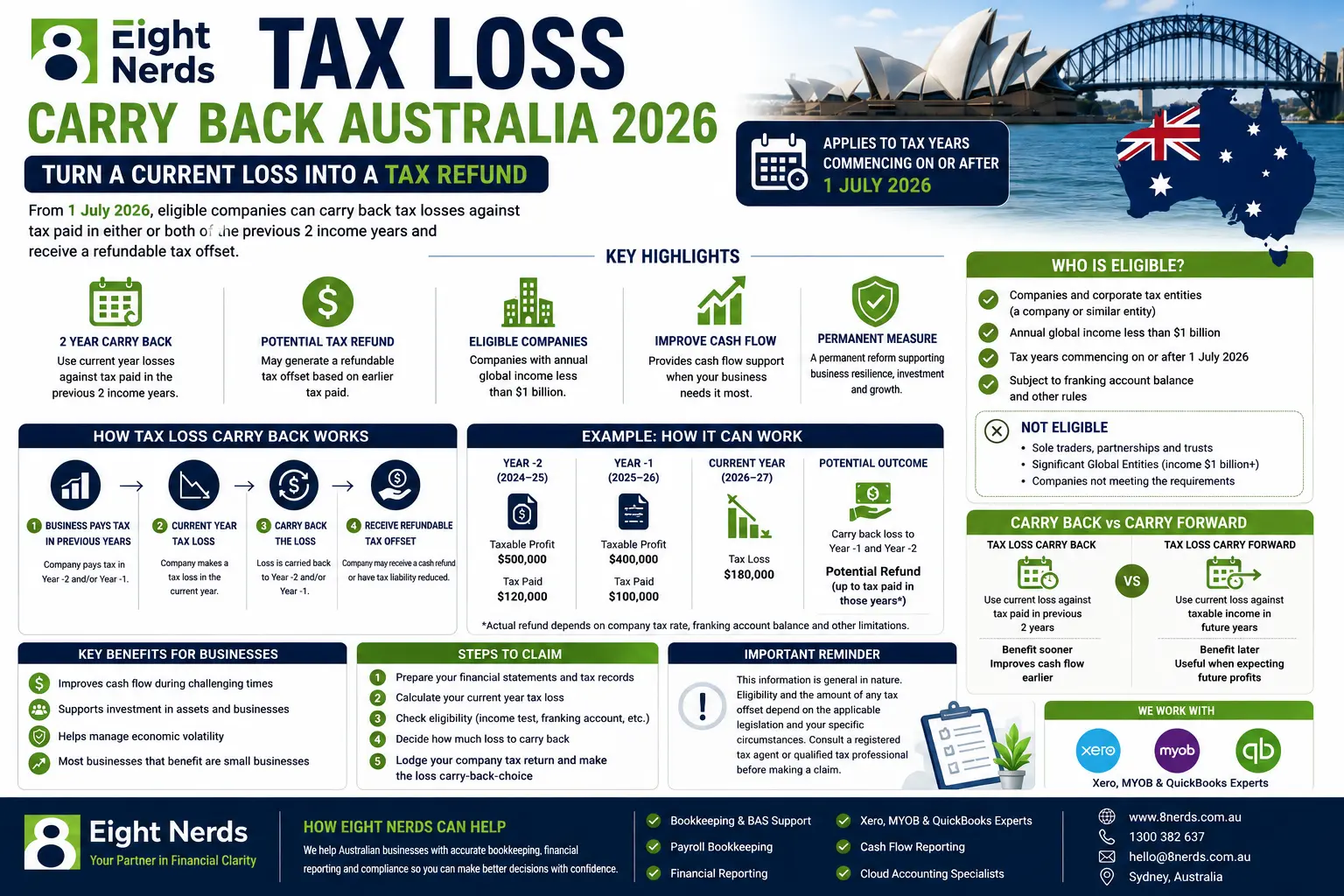
Under the new permanent measure, eligible companies with annual global income of less than $1 billion can carry back a tax loss and apply it against tax paid in either or both of the previous two income years, potentially generating a refundable tax offset.
The measure is designed to improve business cash flow and help companies manage temporary downturns while continuing to invest, employ staff, and operate their businesses.
For Australian business owners, understanding how Tax Loss Carry Back Australia works is important because a tax loss does not necessarily mean that the business has to wait years before receiving any tax benefit.
What Is Tax Loss Carry Back in Australia?
Tax loss carry back allows an eligible company to use a tax loss from a current income year against income tax it paid in an earlier income year.
Normally, when a company makes a tax loss, it can generally carry that loss forward and potentially use it against taxable income in future years. Tax loss carry back works differently because it looks backwards rather than forwards.
For example, imagine an Australian company:
- Paid $120,000 in company tax in an earlier year.
- Experienced a significant downturn in the following year.
- Generated a tax loss in the current year.
Under the new Tax Loss Carry Back Australia 2026 rules, if the company meets all eligibility requirements, it may be able to carry back some or all of its eligible loss against tax paid in one or both of the previous two income years and receive a refundable tax offset.
This can potentially provide cash-flow support at a time when the business needs it most.
Why Has Tax Loss Carry Back Been Reintroduced in Australia?
The Australian Government has reintroduced permanent two-year loss carry back as part of a broader package of business tax reforms.
The reform is intended to support business resilience, investment, innovation, and cash flow. Treasury has stated that the measure could benefit up to approximately 85,000 companies each year, with most beneficiaries expected to be small businesses.
The policy is particularly relevant to established businesses that have previously been profitable but experience a temporary downturn.
For example, a company might have:
- Invested heavily in new equipment.
- Expanded into a new market.
- Experienced a temporary reduction in customer demand.
- Faced increased operating costs.
- Experienced an unexpected economic shock.
- Increased spending on technology or business infrastructure.
A temporary loss does not necessarily mean the underlying business is unsuccessful. Tax Loss Carry Back Australia can potentially provide a tax benefit from earlier profitable years while the company works through the difficult period.
Who Is Eligible for Tax Loss Carry Back Australia 2026?
One of the most important questions businesses have is:
Who can claim Carry Back Australia in 2026?
The new measure applies to eligible companies and corporate tax entities that are not significant global entities, with annual global income of less than $1 billion. The rules apply to tax years commencing on or after 1 July 2026.
This means the measure is not simply available to every Australian business that makes a loss.
The eligibility rules need to be considered carefully, including the company’s tax position and other requirements under the tax legislation.
Businesses should therefore check their circumstances before assuming that a tax loss automatically creates a refundable tax offset.
Can a Small Business Claim Tax Loss Carry Back?
Yes, an eligible small business operating through a company structure may be able to use Tax Loss Carry Back Australia if it meets the relevant requirements.
This is particularly important because many Australian small businesses operate through companies and can experience significant changes in taxable income from one year to another.
For example, a small construction company might have:
2025–26:
Taxable income: $500,000
Company tax paid: applicable tax liability
2026–27:
Major investment and lower project revenue
Taxable loss: $300,000
If the company satisfies the relevant requirements, it may be able to carry back some or all of the loss against tax paid in an earlier year.
The actual tax offset depends on the amount of eligible loss, prior tax liabilities, the applicable company tax rate, the franking account balance, and other statutory limitations.
Can Sole Traders Claim Tax Loss Carry Back in Australia?
This is an important distinction.
The new Tax Loss Carry Back Australia 2026 measure is designed for eligible companies and corporate tax entities. It is not a general tax refund mechanism available to every sole trader, partnership, or individual business owner.
Sole traders have different tax-loss rules because the business income and loss is generally dealt with in the individual’s tax return.
For this reason, a sole trader should not assume that the company loss carry-back rules apply to their business.
If your business operates through a sole trader, partnership, trust, or company structure, the tax treatment of losses can be different.
How Far Back Can a Company Carry a Tax Loss?
The new Australian rules provide a two-year loss carry-back period.
An eligible company can potentially carry a current-year tax loss back against tax paid in either or both of the previous two income years.
This is one of the most important features of the new Tax Loss Carry Back Australia rules.
For example:
| Income Year | Business Result |
|---|---|
| 2024–25 | Taxable profit and tax paid |
| 2025–26 | Taxable profit and tax paid |
| 2026–27 | Tax loss |
| 2027–28 | Potential future year |
For a qualifying 2026–27 loss, the company may potentially look back to the previous two income years, subject to the detailed rules.
The company does not simply receive a refund for the entire amount of the loss. The loss carry-back calculation determines the amount of refundable tax offset available.
How Much Tax Refund Can a Company Receive?
The amount of the potential refund depends on several factors.
It is important to understand that a $100,000 tax loss does not automatically mean a $100,000 tax refund.
The loss is converted into a tax offset based on the applicable rules and is subject to limitations.
The amount can be affected by:
- The company’s tax loss.
- Tax paid in the previous two income years.
- The applicable corporate tax rate.
- The company’s franking account balance.
- The amount of loss chosen to be carried back.
- Other requirements under the tax legislation.
Treasury has specifically noted that the measure is subject to the company’s franking account balance, helping ensure that refunds are appropriately limited to prior tax paid.
This is why businesses should not calculate their potential refund simply by multiplying a tax loss by a tax rate without considering the full rules.
Tax Loss Carry Back Example for an Australian Company
Consider an Australian company that has previously been profitable.
During an earlier income year, the company paid $90,000 in company income tax.
In the following year, the company experiences a major downturn and calculates a tax loss of $200,000.
The company may potentially be able to carry back some of that loss against tax paid in the earlier eligible years.
However, the actual refundable tax offset will depend on the applicable tax rate, prior tax liabilities, franking account balance, and other limitations.
The important point is that loss carry back can potentially turn part of a current-year tax loss into a refundable tax offset rather than requiring the company to wait until a future profitable year to use the loss.
This can be particularly valuable for businesses experiencing temporary financial pressure.
What Is the Difference Between Tax Loss Carry Back and Tax Loss Carry Forward?
This is one of the most common questions about Tax Loss Carry Back Australia.
Tax Loss Carry Back
A current-year tax loss is applied against eligible tax paid in previous years.
Direction:
Current loss → Previous tax years
Taxation Loss Carry Forward
A current-year tax loss is retained and potentially used against taxable income in future years.
Direction:
Current loss → Future profitable years
The two approaches serve different purposes.
Tax loss carry back can potentially provide a cash-flow benefit sooner, while tax loss carry forward can remain useful when a company expects to return to profitability in future years.
Businesses should consider which treatment is appropriate under the rules rather than assuming that carrying a loss back is always better.
Does Tax Loss Carry Back Mean the ATO Will Automatically Refund the Tax?
No.
An eligible company generally needs to choose to claim the loss carry-back tax offset as part of the relevant company tax return process.
The tax benefit is not simply an automatic refund triggered whenever a company records a loss.
This makes accurate tax records and company tax return preparation important.
The company needs to determine whether it qualifies, calculate the amount that can be carried back, and complete the relevant tax reporting correctly.
Because the measure involves corporate tax losses, previous tax liabilities, and franking account considerations, professional tax advice may be appropriate.
How Does Tax Loss Carry Back Affect Cash Flow?
One of the biggest potential benefits of Tax Carry Back Australia 2026 is improved business cash flow.
Imagine a company that paid significant income tax during profitable years but then experiences a temporary downturn.
Without loss carry back, the company may have to carry the tax loss forward and wait until a future profitable year to use it.
With an eligible loss carry-back claim, the company may potentially receive a refundable tax offset based on earlier tax paid.
That could provide additional funds that the business can use for:
- Working capital
- Employee wages
- Supplier payments
- Business expansion
- Technology investment
- Equipment
- Marketing
- Debt management
- Operational expenses
The purpose is not simply to reduce tax. It can also help businesses manage financial volatility.
Can Loss Carry Back Help a Business That Invested Heavily?
Yes, this is one of the situations where the measure may be particularly relevant.
A company can sometimes become temporarily loss-making because it makes a significant investment.
For example, a manufacturing company may spend heavily on new machinery and technology. A professional services company may invest in a new platform or expansion. A growing business may increase staff and operating costs before the additional revenue arrives.
The Government has specifically highlighted that loss carry back can support companies that incur losses after investing in new assets, including assets eligible for the permanent $20,000 instant asset write-off.
This creates an interesting connection between two Australian business tax measures:
Investment → Tax deductions → Temporary tax loss → Potential loss carry back → Improved cash flow
However, each measure has its own eligibility requirements.
What Records Does a Business Need for Tax Loss Carry Back?
Accurate financial records are extremely important when considering a Tax Loss Carry Back Australia claim.
Businesses should maintain records that support:
- Revenue
- Business expenses
- Tax deductions
- Depreciation
- Asset purchases
- Payroll
- GST records
- Previous company tax returns
- Income tax paid
- Taxable income calculations
- Company financial statements
- Franking account information
A tax loss should not simply be based on a bank balance.
A business can have positive cash flow and still have a tax loss, or have cash-flow difficulties while reporting taxable income. Tax losses are calculated under tax rules and can differ from accounting losses.
This is why professional bookkeeping and tax preparation are important.
How Bookkeeping Helps With Tax Loss Carry Back Australia
Good bookkeeping does not itself create a tax loss or determine eligibility, but it provides the financial records needed to calculate and support the company’s tax position.
Regular bookkeeping helps ensure that:
- Revenue is recorded correctly.
- Expenses are categorised accurately.
- Bank accounts are reconciled.
- Asset purchases are recorded.
- Payroll records are maintained.
- Financial reports are available.
- Previous tax information can be reviewed.
- Transactions can be traced back to supporting documents.
Cloud accounting platforms such as Xero, MYOB, and QuickBooks can help businesses maintain organised financial records throughout the year.
For a company considering a loss carry-back claim, having clean records can make the process much more efficient.
How Eight Nerds Can Help Australian Businesses
At Eight Nerds, we help Australian businesses maintain accurate and organised bookkeeping records using modern accounting platforms including Xero, MYOB, and QuickBooks.
Our team supports businesses with the financial record-keeping processes that underpin accurate reporting and tax preparation.
Our bookkeeping services can include:
- Transaction recording
- Bank reconciliation
- Accounts payable
- Accounts receivable
- Expense categorisation
- Asset record management
- Payroll-related bookkeeping
- Financial reporting
- GST record management
- BAS preparation support
- Xero, MYOB, and QuickBooks bookkeeping
As a Xero Certified Advisor, Eight Nerds can help businesses make better use of cloud accounting technology while keeping their financial records organised.
For businesses considering the Tax Loss Carry Back Australia 2026 rules, accurate records can make it easier for their tax professional to assess the company’s position and determine whether a claim may be available.
Eight Nerds focuses on the bookkeeping side of the process, while tax agents and qualified tax professionals can provide specific tax advice and determine eligibility for a particular claim.
Tax Loss Carry Back Australia: Common Mistakes to Avoid
Businesses should be careful not to assume that every tax loss qualifies for a refund.
Common mistakes include:
- Assuming all business structures qualify.
- Confusing accounting losses with tax losses.
- Assuming a $100,000 loss equals a $100,000 refund.
- Ignoring previous tax liabilities.
- Failing to consider the franking account.
- Not maintaining records from previous tax years.
- Forgetting that the measure applies to eligible companies.
- Assuming the loss carry-back rules apply to sole traders.
- Claiming an offset without confirming eligibility.
- Failing to maintain accurate company tax records.
Professional review can be particularly useful where the company has undergone ownership changes, restructuring, acquisitions, major asset purchases, or significant changes in its business activities.
Frequently Asked Questions About Tax Loss Carry Back Australia
What is Tax Loss Carry Back Australia?
It allows eligible companies to carry a current tax loss back against tax paid in either or both of the previous two income years, potentially generating a refundable tax offset. The new permanent measure applies to tax years commencing on or after 1 July 2026.
When does Tax Loss Carry Back start in Australia?
The new loss carry-back measure applies to tax years commencing on or after 1 July 2026.
How many years can a company carry back a tax loss?
Under the new measure, an eligible company can potentially carry a tax loss back two income years.
Can a sole trader carry back a tax loss?
The new Tax Loss Carry Back measure is for eligible companies and corporate tax entities. Sole traders have different tax-loss rules and should not assume that the company loss carry-back measure applies to them.
Can a small business claim Tax Loss Carry Back?
An eligible small business operating through a company may be able to claim the tax loss carry-back tax offset if it satisfies the applicable requirements.
What is the turnover limit for Tax Loss Carry Back Australia 2026?
The measure applies to eligible companies with annual global income of less than $1 billion, subject to the detailed legislative requirements.
Is Tax Loss Carry Back a tax refund?
It can result in a refundable tax offset. This means an eligible company may potentially receive cash back, have a tax liability reduced, or have an existing debt with the ATO reduced, depending on its circumstances and the amount of offset available.
Does Tax Loss Carry Back apply automatically?
No. An eligible company needs to make the relevant choice and claim the tax offset through the applicable company tax return process.
Can a company carry back the same loss and carry it forward?
A tax loss cannot simply be used twice. Businesses need to calculate how much of the loss is carried back and how much remains available under the applicable carry-forward rules.
Does the franking account affect Tax Loss Carry Back?
Yes. The new measure is subject to the company’s franking account balance, which can limit the amount of refundable tax offset available.
Can a company claim Tax Loss Carry Back if it never paid tax before?
The main benefit of loss carry back comes from having eligible prior-year tax liabilities to offset. A company that has not previously paid relevant income tax may have little or no carry-back benefit and may instead need to rely on the ordinary tax-loss carry-forward rules.
Is Tax Loss Carry Back the same as Tax Loss Carry Forward?
No. Carry back applies a current loss against eligible earlier tax years, while carry forward allows eligible losses to potentially reduce taxable income in future years.
Can this improve business cash flow?
Potentially, yes. A refundable tax offset from an eligible loss carry-back claim can provide cash-flow support to a company that previously paid tax but is now experiencing a loss.
How to claim your loss carry back?
The Loss Carry Back Australia 2026 reform is an important development for eligible Australian companies. From tax years commencing on or after 1 July 2026, eligible companies with annual global income below $1 billion can potentially carry back a tax loss against tax paid in either or both of the previous two income years. The measure can generate a refundable tax offset and is designed to support business resilience, investment, and cash flow.
For businesses that have been profitable in previous years but are experiencing a temporary downturn, this can be particularly valuable. It may provide access to a tax benefit sooner rather than requiring the company to wait until a future profitable year.
However, Tax Loss Carry Back Australia is not an automatic refund for every business loss. Eligibility, company structure, annual global income, previous tax liabilities, franking account balances, and other legislative requirements all need to be considered.
The best starting point is accurate bookkeeping and well-maintained financial records. With organised records in Xero, MYOB, or QuickBooks, businesses can give their tax professional a clearer picture of their financial position and make the tax-return process more efficient.
At Eight Nerds, we support Australian businesses with professional bookkeeping, financial reporting, GST records, payroll-related bookkeeping, and accounting software support. Our team helps businesses keep their financial information organised so they can make better decisions and work more efficiently with their accountants and tax professionals.
This article provides general information about Tax Loss Carry Back Australia and should not be treated as individual tax advice. Eligibility and the amount of any tax offset depend on the applicable legislation and the company’s specific circumstances. Businesses should consult a registered tax agent or qualified tax professional before making a loss carry-back claim.