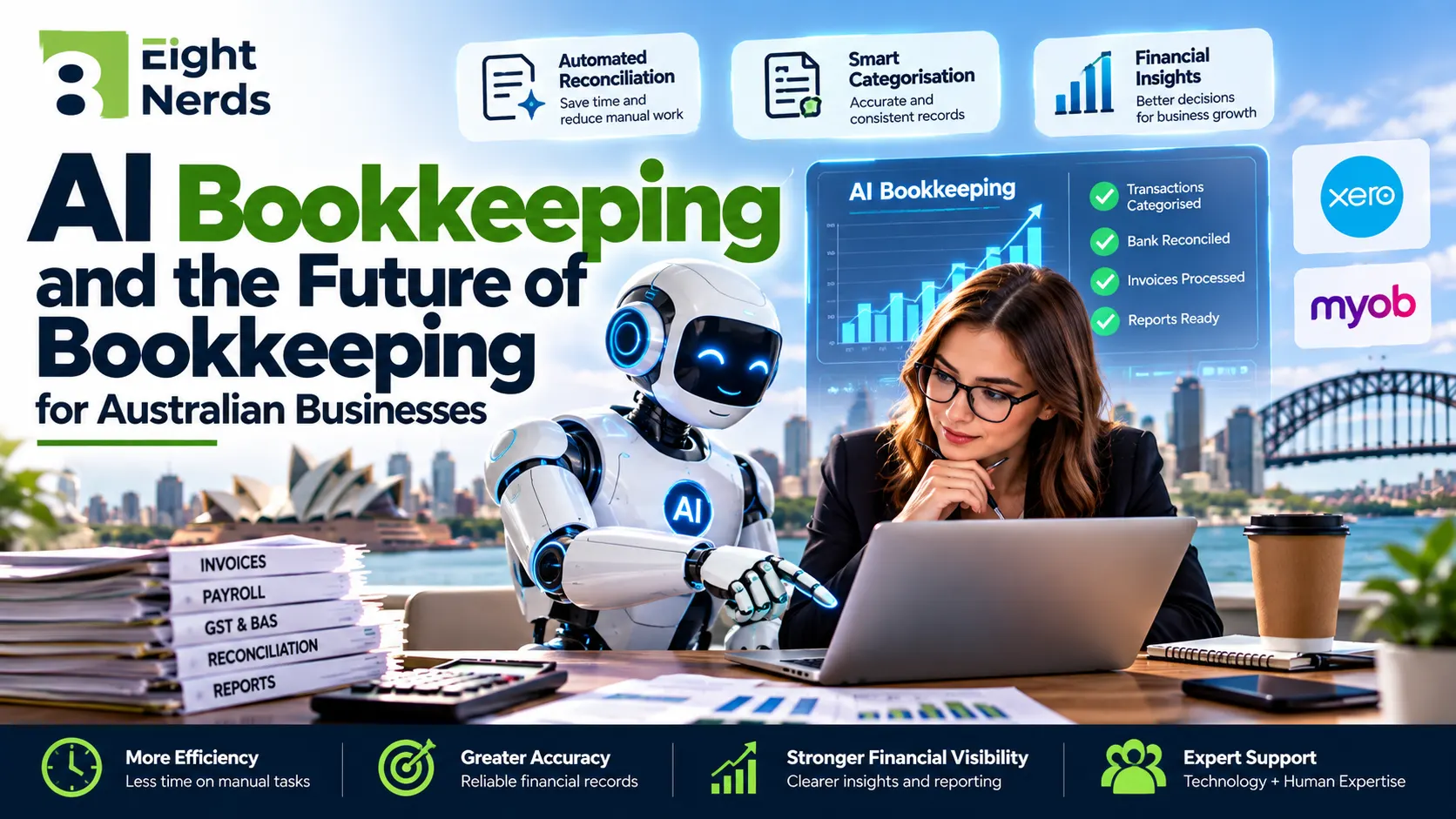
Bookkeeping is changing faster than it has in years. Accounting software can now recognise transaction patterns, automate reconciliation, capture financial documents and provide businesses with information that previously required significant manual work. For Australian businesses, this shift is making AI bookkeeping a practical part of modern financial management rather than something limited to technology discussions.
But the real change is not simply that software can process transactions faster. The bigger change is happening in the role of the bookkeeper itself. As artificial intelligence takes care of more repetitive bookkeeping tasks, financial professionals can spend more time reviewing information, identifying unusual transactions, maintaining financial accuracy and helping businesses understand what their numbers are actually saying.
Xero and MYOB are already incorporating AI into everyday accounting processes in Australia. Current features include automated bank reconciliation, transaction categorisation, receipt and bill processing, financial insights and support with BAS-related processes. Xero
For a growing business, this creates an important opportunity. The objective should not be to remove people from the bookkeeping process altogether. It should be to combine intelligent technology with experienced financial oversight so that bookkeeping becomes faster, more accurate and more useful to the business.
AI Bookkeeping Is Changing More Than Data Entry
Traditional bookkeeping has always included repetitive activities. Transactions have to be recorded, bank accounts reconciled, expenses categorised, invoices processed and supporting documents maintained. When transaction volumes increase, these tasks can consume a considerable amount of time.
AI bookkeeping changes the amount of manual work involved in these processes.
Modern accounting systems can identify transaction patterns, suggest categories, match bank transactions with accounting records and process financial documents. In some situations, software can deal with routine transactions automatically and leave exceptions for a person to review.
This creates a different workflow from traditional bookkeeping. Instead of a bookkeeper spending the majority of their time manually processing every transaction, more of their time can be directed towards reviewing the quality of the bookkeeping and dealing with transactions that require judgement.
That distinction matters because financial transactions are not always as straightforward as they appear on a screen. A payment could represent an ordinary operating expense, an asset purchase, a loan movement, a transfer between accounts or a transaction requiring a particular GST treatment.
Automation can identify a likely match. Professional judgement is still needed to determine whether that treatment makes sense for the business.
Xero currently describes its AI capabilities as handling tasks such as bank reconciliation, transaction categorisation and document capture, with automated actions recorded for review. Xero
Bank Reconciliation Is Becoming a Smarter Process | Bookkeping & AI Capability
Bank reconciliation is one of the clearest examples of how AI bookkeeping is changing day-to-day financial administration.
A business with hundreds or thousands of transactions does not want its finance team spending unnecessary hours manually matching every payment and receipt. Modern accounting platforms can analyse transaction information and suggest or automatically identify matches based on established patterns.
Xero’s current AI accounting capabilities include automatic bank reconciliation, while MYOB’s Smart Reconciliation is designed to automatically match transactions and leave the remaining items for review. Xero
The benefit is not simply speed.
When reconciliations are maintained continuously rather than being left until the end of a reporting period, businesses can have a more current view of their financial position. Problems can also become easier to identify because unusual transactions, missing records or unmatched payments are not buried under months of accumulated bookkeeping work.
That is particularly valuable for businesses with high transaction volumes, multiple bank accounts, large payrolls, ecommerce payments or a growing number of suppliers and customers.
AI can reduce the repetitive side of reconciliation. A professional bookkeeper still needs to investigate exceptions and make sure the underlying records accurately represent the business.
The Accuracy Question Has Not Gone Away
One of the biggest mistakes businesses can make is assuming that automation automatically means accuracy. AI systems learn from available financial information and established patterns. When the underlying bookkeeping is inconsistent, poorly structured or incomplete, automated processes may not produce the results a business expects.
This is why the quality of the accounting setup becomes even more important as businesses adopt AI bookkeeping.
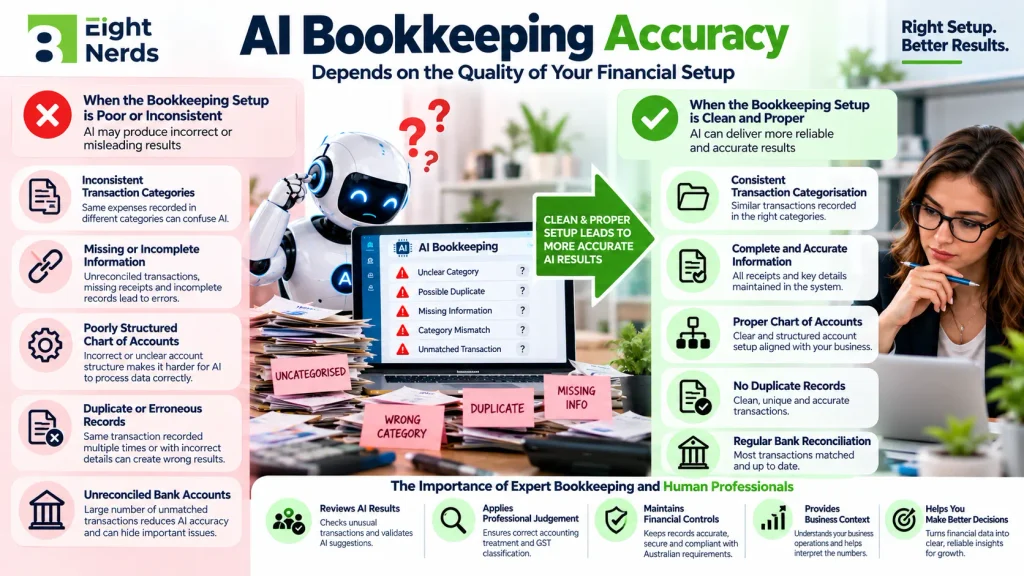
The chart of accounts needs to be appropriate. Bank accounts need to be connected correctly. GST treatment needs to be reviewed. Payroll needs to be properly recorded. Customer and supplier transactions need to be maintained consistently. Ecommerce settlements and payment gateway transactions need to be reconciled against the right source information.
A well-configured system gives AI better information to work with. A poorly maintained system can simply make incorrect processing happen more efficiently. For this reason, AI bookkeeping should be viewed as an enhancement to a financial process rather than a substitute for financial controls.
GST and BAS Are Becoming More Connected to Everyday Bookkeeping
Australian businesses have ongoing GST and BAS obligations, making the quality of everyday bookkeeping particularly important. When transactions are categorised and reconciled correctly throughout the quarter, the information supporting GST calculations and BAS preparation can remain more current. This is one area where accounting automation can reduce the amount of last-minute bookkeeping that often happens before a reporting deadline.
Xero’s current AI accounting tools connect automated transaction processing with GST and BAS information, while MYOB’s AI BAS functionality is designed to identify items requiring attention during the quarter, including missing information and potential GST issues. Xero
This does not mean that AI independently takes responsibility for compliance.
Human review continues to matter, particularly where transactions are unusual, the accounting treatment is complicated or a business has multiple activities that affect its GST position. MYOB specifically states that users remain responsible for reviewing AI BAS results and for the accuracy and compliance of their lodgement. MYOB
The value of AI is therefore in keeping the bookkeeping process moving throughout the reporting period instead of allowing financial administration to become a quarterly clean-up exercise.
Growing Businesses Have More to Gain From Better Bookkeeping Technology
AI bookkeeping becomes particularly valuable as a business becomes more complex.
A growing company may have more employees, more suppliers, more customers, higher transaction volumes and additional revenue channels. An ecommerce business may have Shopify sales alongside marketplace transactions, payment gateways, refunds, fulfilment costs and inventory movements. A professional services company may have recurring clients, employee payroll, subcontractors and multiple business accounts.
At a certain point, bookkeeping stops being a simple administrative task.
The business needs financial information that can keep pace with its operations.
Automation can help process higher transaction volumes without requiring every additional transaction to create an equivalent amount of manual work. But technology becomes most useful when it sits inside a properly managed financial system.
For established businesses, the important question is not simply whether AI can reconcile transactions. The question is whether the overall bookkeeping process gives management reliable information about revenue, expenses, profitability, cash flow, liabilities and business performance.
Ecommerce Is One Area Where AI Bookkeeping Has Real Potential
Ecommerce bookkeeping is particularly complicated because the money flowing through an online business does not always move directly from customer to bank account.
An online business can have sales recorded on Shopify or another ecommerce platform, payments processed through different gateways, marketplace settlements deposited days later, refunds issued separately and fees deducted before funds reach the business bank account.
As sales volume grows, manually understanding these transactions can become difficult.
AI bookkeeping can help automate parts of the transaction processing and reconciliation workflow. However, the accounting structure still needs to reflect how the ecommerce business actually operates.
Sales, fees, refunds, inventory purchases, cost of goods sold and settlement payments need to be correctly connected. Otherwise, an impressive-looking dashboard can still provide a misleading picture of profitability.
For ecommerce businesses, good bookkeeping is not just about knowing how much was sold. It is about understanding how those sales translate into revenue, margins and available cash.
The Value of AI Goes Beyond Reconciliation
The next stage of AI bookkeeping is not only about recording transactions. It is about helping businesses understand their financial information.
Modern AI accounting systems are increasingly introducing financial insight features that allow businesses to identify trends in income, spending, cash position and other areas of financial performance. MYOB, for example, currently offers AI Business Insights designed to highlight trends in costs, income and cash management, while Xero’s AI platform includes financial insight and cash-flow capabilities. Xero
This changes the purpose of bookkeeping.
A business owner does not ultimately care about whether a transaction was matched because matching itself has no commercial value. The value comes from what accurate financial information allows the business owner to understand.
Are margins improving?
Are expenses rising faster than revenue?
Are customers taking too long to pay?
Is inventory consuming too much cash?
Can the business afford another employee?
Is there enough working capital for the next stage of growth?
These are financial management questions, not data-entry questions.
AI can help surface information more quickly, but interpreting that information in the context of the business remains a human responsibility.
Human Expertise Still Matters | AI Bookkeeping vs Human Experience
The idea that AI bookkeeping will completely eliminate bookkeepers misunderstands where the value of bookkeeping is moving.
When repetitive work becomes easier to automate, professional expertise becomes more focused on review, judgement and interpretation.
A strong financial professional may spend less time entering routine transactions and more time investigating unusual activity, improving financial controls, reviewing monthly reports, coordinating with accountants and helping management understand changes in business performance.
Xero itself positions its AI tools as working alongside, rather than replacing, accountants and advisors. MYOB similarly describes AI as supporting users while keeping people in control of financial decisions and reviews. Xero
For businesses, this can be a significant advantage.
The goal should be to let technology handle repetitive work while experienced professionals concentrate on the areas where judgement matters most.
Good Financial Data Becomes Even More Important
AI does not remove the need for disciplined bookkeeping. It actually makes good financial data more important.
A business that has large numbers of uncategorised transactions, duplicated entries, inconsistent account structures or unreconciled balances cannot expect an AI system to solve every underlying problem.
Before businesses think about adding more automation, they should make sure the foundations are reliable.
This means having clean accounting records, correctly configured software, appropriate account categories, consistent transaction handling and a clear process for reviewing exceptions.
Once those foundations are established, AI bookkeeping can become far more effective.
The technology can then help maintain the system instead of trying to repair a broken one.
The Bookkeeper’s Role Is Moving Closer to Financial Management
The future of bookkeeping is likely to involve less repetitive processing and more financial oversight.
A modern bookkeeper can become the person who makes sure accounting information stays accurate, reconciliations remain under control, financial records are maintained correctly and reports are ready when management needs them.
That creates a natural connection between bookkeeping and wider financial services.
A growing business may need bookkeeping today, but as complexity increases it may also need payroll management, accounts payable and receivable support, GST and BAS assistance, financial reporting, cash-flow management and eventually Virtual CFO support.
This broader financial support model is more useful than treating bookkeeping as an isolated administrative function.
Choosing the Right Approach to AI Bookkeeping
Businesses should not adopt AI bookkeeping simply because AI is becoming popular.
The right question is whether the technology improves the financial process without reducing visibility or control.
The accounting platform should suit the business. Automation should be configured around actual workflows. Important transactions should remain subject to appropriate review. The business should know how its data is being processed and who is responsible for checking the results.
Most importantly, automation should create better financial information rather than simply more automated activity.
For an established business, saving time is useful. Having accurate financial information available when a major decision needs to be made is considerably more valuable.
Where AI Bookkeeping Is Taking Australian Businesses
The future of bookkeeping in Australia is unlikely to be completely manual, but it is also unlikely to be completely autonomous.
AI will continue taking over repetitive financial tasks. Reconciliation, document capture, transaction categorisation and financial analysis are already moving in that direction. Xero and MYOB are both expanding AI capabilities across everyday accounting workflows and business insights. Xero
At the same time, businesses will continue to need experienced people who can review financial information, recognise problems, understand compliance requirements and explain what the numbers mean in a commercial context.
That combination is where AI bookkeeping becomes genuinely valuable. Technology can make bookkeeping faster. Good processes can make it more consistent. Experienced financial professionals can make the information useful.
For Australian businesses that are growing, hiring employees, managing multiple revenue streams, selling online or dealing with increasingly complex financial operations, that combination can provide a much stronger financial foundation.
Modern Bookkeeping With 8Nerds
At 8Nerds, bookkeeping is approached as part of a broader financial management function rather than simply a transaction-processing exercise. Businesses can combine professional bookkeeping with payroll management, GST and BAS support, accounts management, financial reporting and Virtual CFO services as their requirements develop.
The role of modern bookkeeping is not only to keep financial records updated. It is to make sure business owners have reliable information they can use to manage operations, understand performance and make better financial decisions.
AI can handle more of the repetitive work, but businesses still need experienced professionals who know when something does not look right and understand what should happen next.
That is the real future of AI bookkeeping in Australia: technology doing more of the repetitive work while human expertise focuses on accuracy, context, control and business growth.
Frequently Asked Questions About AI Bookkeeping
What is AI bookkeeping?
AI bookkeeping refers to the use of artificial intelligence within accounting and bookkeeping systems to automate or assist with tasks such as bank reconciliation, transaction categorisation, receipt and bill processing, financial analysis and other repetitive financial processes.
Can AI replace a bookkeeper?
AI can replace or reduce significant amounts of repetitive bookkeeping work, but it does not remove the need for human review and financial judgement. Businesses still need professionals who can investigate unusual transactions, maintain financial controls and understand the commercial meaning behind their financial information.
Is AI bookkeeping suitable for Australian businesses?
Yes. AI capabilities are increasingly being built directly into accounting platforms used by Australian businesses, including features covering reconciliation, transaction processing, financial insights and BAS-related workflows. Xero
Can AI help with BAS preparation?
AI can support the bookkeeping and preparation process by helping categorise transactions, identify missing information and keep GST-related records more current. However, businesses remain responsible for reviewing the information and ensuring their BAS is accurate and compliant before lodgement. MYOB
Does AI bookkeeping work with Xero?
Yes. Xero currently has AI-powered capabilities covering areas such as bank reconciliation, transaction categorisation, receipt and bill capture, GST and BAS information and financial insights. Xero
Does MYOB use AI for bookkeeping?
Yes. MYOB currently offers AI-powered functionality including Smart Reconciliation, financial insights and AI BAS capabilities for eligible Australian businesses. MYOB
Is AI bookkeeping accurate?
AI can process routine financial information efficiently, but businesses should not assume that every automated result is automatically correct. Important or unusual transactions still require review, and the quality of the underlying accounting data has a major effect on the usefulness of automation.
The Future Is Not AI Instead of Bookkeeping
The future of bookkeeping is not about choosing between artificial intelligence and experienced financial professionals.
It is about using each for what they do best.
AI can process repetitive information, identify patterns and automate routine workflows. Experienced bookkeeping and accounting professionals can review the results, understand exceptions, maintain financial controls and connect the numbers to real business decisions.
For Australian businesses, that creates an opportunity to move beyond basic bookkeeping and build a financial system that is more current, more efficient and more useful.
AI Bookkeeping With Eight Nerds (8 Nerds)
At Eight Nerds, we see AI bookkeeping as a tool for building a better financial process, not as a replacement for professional expertise. Our approach combines modern accounting technology with experienced financial support across bookkeeping, payroll management, GST and BAS, accounts payable and receivable, financial reporting and Virtual CFO services. For Australian businesses that are growing and becoming more financially complex, the goal is to keep the books accurate, make financial information easier to understand and give business owners greater confidence in the numbers behind their decisions. With the right technology and the right people working together, AI bookkeeping can become part of a more efficient, reliable and commercially focused financial system.
AI bookkeeping is not about removing the human element from finance. It is about giving financial professionals better technology so they can spend more time on the work that actually matters.